Giải SBT tiếng Anh 9 Unit 1–12 Global Success có đáp án chi tiết

Sách bài tập tiếng Anh 9 không chỉ là nơi luyện tập mà còn giúp bạn củng cố toàn diện từ vựng, ngữ pháp và kỹ năng theo từng Unit trong chương trình Global Success.
Tuy nhiên, nếu chỉ làm bài mà không kiểm tra, phân tích lỗi sai, bạn rất dễ học lệch hoặc bỏ sót kiến thức quan trọng.
Chính vì vậy, bộ Giải SBT tiếng Anh 9 Unit 1–12 Global Success được tổng hợp đầy đủ, kèm đáp án chi tiết và hướng dẫn làm bài rõ ràng sẽ giúp bạn hiểu sâu – nhớ lâu – áp dụng đúng.
Từ việc nắm chắc từng dạng bài đến luyện tập với các phần TEST YOURSELF, bạn hoàn toàn có thể tự tin ôn tập và bứt phá điểm số một cách hiệu quả.
Table of Contents
Sách bài tập tiếng Anh 9 gồm những nội dung nào?
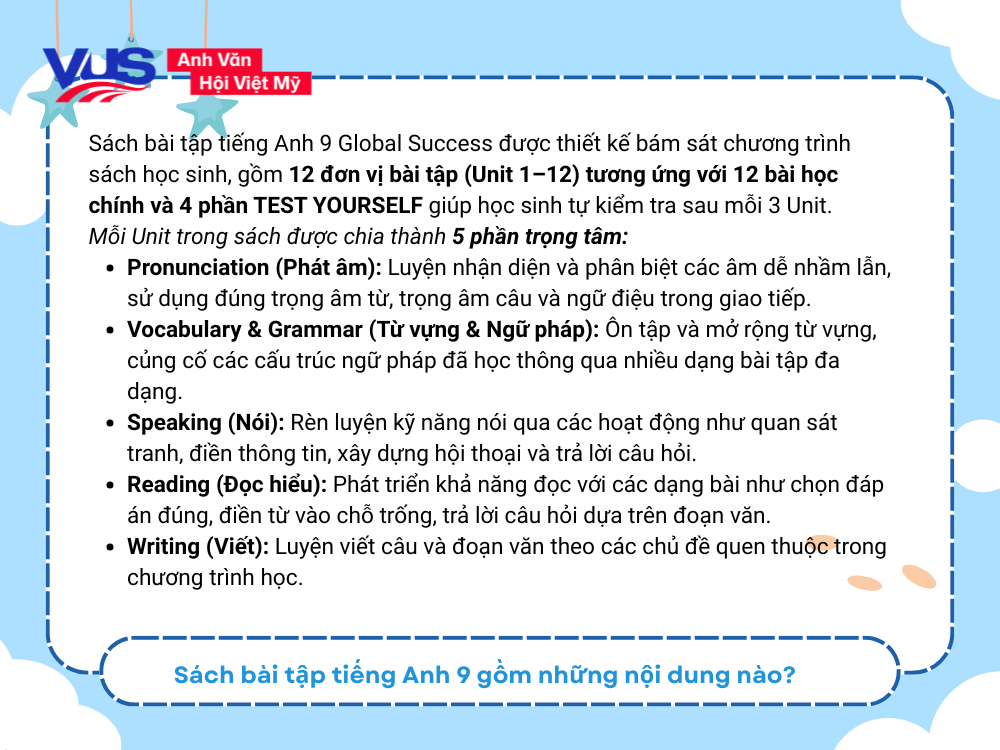
Sách bài tập tiếng Anh 9 Global Success được thiết kế bám sát chương trình sách học sinh, gồm 12 đơn vị bài tập (Unit 1–12) tương ứng với 12 bài học chính và 4 phần TEST YOURSELF giúp học sinh tự kiểm tra sau mỗi 3 Unit.
Nội dung được xây dựng theo hướng vừa củng cố kiến thức, vừa phát triển toàn diện các kỹ năng ngôn ngữ.
Mỗi Unit trong sách được chia thành 5 phần trọng tâm:
- Pronunciation (Phát âm): Luyện nhận diện và phân biệt các âm dễ nhầm lẫn, sử dụng đúng trọng âm từ, trọng âm câu và ngữ điệu trong giao tiếp.
- Vocabulary & Grammar (Từ vựng & Ngữ pháp): Ôn tập và mở rộng từ vựng, củng cố các cấu trúc ngữ pháp đã học thông qua nhiều dạng bài tập đa dạng.
- Speaking (Nói): Rèn luyện kỹ năng nói qua các hoạt động như quan sát tranh, điền thông tin, xây dựng hội thoại và trả lời câu hỏi.
- Reading (Đọc hiểu): Phát triển khả năng đọc với các dạng bài như chọn đáp án đúng, điền từ vào chỗ trống, trả lời câu hỏi dựa trên đoạn văn.
- Writing (Viết): Luyện viết câu và đoạn văn theo các chủ đề quen thuộc trong chương trình học.
Bên cạnh đó, TEST YOURSELF 1–4 giúp học sinh tổng hợp kiến thức và làm quen với cấu trúc bài kiểm tra, hỗ trợ tốt cho việc ôn thi. Cuối sách còn có bảng động từ bất quy tắc để tra cứu nhanh, cùng hệ thống bài tập phong phú, có hình ảnh minh họa sinh động giúp việc học trở nên trực quan và dễ hiểu hơn.
Các chủ điểm học xuyên suốt 12 unit bao gồm:
- Unit 1: Local Community
- Unit 2: City Life
- Unit 3: Healthy Living for Teens
- Unit 4: Remembering the Past
- Unit 5: Our Experiences
- Unit 6: Vietnamese Lifestyle: Then and Now
- Unit 7: Natural Wonders of the World
- Unit 8: Tourism
- Unit 9: World Englishes
- Unit 10: Planet Earth
- Unit 11: Electronic Devices
- Unit 12: Career Choices
Tham khảo chi tiết: Ngữ pháp tiếng Anh lớp 9
Xem thêm: Bộ đề thi tuyển sinh lớp 10 môn Anh các năm, đề minh họa 2026
Chi tiết giải SBT tiếng Anh 9 Unit 1 - 12 Global Success
Phần Giải SBT tiếng Anh 9 Unit 1–12 Global Success được tổng hợp đầy đủ theo từng Unit, bám sát 100% nội dung sách bài tập, giúp bạn dễ dàng tra cứu đáp án nhanh chóng.
Mỗi bài tập đều có lời giải rõ ràng, trình bày theo đúng thứ tự trong sách, thuận tiện đối chiếu khi tự học tại nhà. Đây là nguồn tài liệu hữu ích để kiểm tra kết quả, rà soát lỗi sai và củng cố lại kiến thức sau khi hoàn thành từng Unit.
Giải SBT tiếng Anh 9 Unit 1 Global Success
1.
/æ/: hand; attraction; wrap; programme; back
/a:/: artist; craft; garbage; heart; tomato
/e/: helper; electrician; especially; step; check-up
2.
- D
- A
- C
- A
- B
B. Vocabulary & Grammar
1. (Crossword answers)
- pottery
- handicraft
- playground
- community
- museum
- artisan
- facility
- suburb
2.
- firefighter
- Police officers
- delivery person
- electrician
- Garbage collectors
- artisans
3.
- C
- D
- B
- C
- A
- D
4.
- D
- A
- B
- C
- B
- C
5.
- A
- A
- D
- B
- A
- C
6.
- In my village, the old artisans pass the techniques to make beautiful baskets down to the younger ones / pass down the techniques to make beautiful baskets to the younger ones.
- When we aren’t at home, our neighbours take care of our cats.
- Her elder sister handed most of her clothes down to Mai / handed down most of her clothes to Mai.
- She and her classmates get on with each other / She gets on with her classmates.
- His hair and face remind me of his father.
C. Speaking
1.
- A
- C
- B
- D
- A
2.
- C
- A
- G
- D
- B
- F
- E
3. Suggested answer:
I live in Hung Yen and my area is famous for banh cuon. It’s famous because it’s a special kind of banh cuon. There is some minced meat inside and people serve it cold, not hot like other kinds. The people in my village still use traditional techniques to make it. Today a lot of households sell it online or open small shops to sell it.
D. Reading
1.
- A
- D
- C
- B
- C
- B
- A
- B
2.
- deliver
- uniform
- before
- remember
- to talk
- leave
- giving
- shares
3.
a.
- d
- e
- b
- c
- a
b.
- T
- F
- T
- T
- F
c.
- Because it combines manual skills and natural resources.
- Sardinian women.
- The technique, the area of production, and the kind of material used.
- Because nowadays it is increasingly rare to find good quality baskets.
- They hope to preserve it / the craft of basket weaving in the future.
E. Writing
1.
- C
- A
- D
- B
- D
2.
- c
- d
- a
- b
- e
3. Suggested answer:
I’m happy to have received your email. I’m going to tell you about the things I like in my community.
The first thing I like about it is the people. They’re kind and friendly. They’re willing to help one another when it’s necessary. When we moved here three years ago, our next-door neighbours came to our house and said hello. They also told us where to buy things for our house. Another thing I like about my community is that it’s very convenient. It’s close to many facilities such as shopping malls, schools, and cinemas. When we need a service, we can get it immediately.
That’s all for now, Mark. Tell me about your community.
Cheers,
Trang
Giải SBT tiếng Anh 9 Unit 2 Global Success
A. Pronunciation
1.
- B
- A
- C
- B
- A
2.
- underground
- airport
- discount
- coach
- square
- coat
/au/: underground, discount
/əʊ/: coach, coat
/eə/: airport, square
B. Vocabulary & Grammar
1.
- D
- B
- A
- C
- D
- B
- A
- C
2.
- D
- C
- A
- A
- B
3.
- liveable
- concrete jungle
- construction sites
- polluted
- public amenities
- security
4.
- busier
- colder
- harder, safer
- The more crowded
- the less friendly
- The closer; the more difficult
- The more expensive; the better
- The further / farther; the less convenient
5.
- A (safer → The safer)
- D (get along → get around)
- C (attractive → more attractive)
- B (out → on)
- B (cut on → cut down on)
- C (denser → the denser)
- B (in → out)
- A (up with → down with)
C. Speaking
1.
- D
- B
- D
- C
- A
2.
- B
- D
- A
- C
- E
3. Suggested answer:
George: I wish I could live in your home town. It’s such a healthy place to live.
Nhung: I like the fresh air here. There are some green parks, and the seafood here is great! How about your home town?
George: Well, I live in a big city. The best thing there is that the public transport system is convenient. I can get around the city by bus and metro.
Nhung: Sounds great.
George: But it’s a bit pricey, and it lacks green spaces. We also need more outdoor sports facilities.
Nhung: Hey, I can take you to the community sports court in my town. It’s quite near here.
George: Thanks. I’d love to. That’s so kind of you.
D. Reading
1.
- D
- B
- A
- C
- C
- B
- A
- D
2
- B
- C
- A
- B
- A
- C
3
a.
- B
- A
- C
- B
- D
b.
- twenty years
- higher
- noise and air
- sleep; breathing (any order)
- house prices
- overcome
E. Writing
1. Suggested answers:
- The dusty road made me have itchy eyes and runny nose.
- The bigger the mall is, the easier it is for people to get lost in it.
- They decided to hang out at the cinema instead of a coffee shop.
- The restaurant was a bit pricey, so it was not popular among teenagers.
- The boy came down with food poisoning after eating street foods.
2.
- C
- B
- A
- D
- D
3. Suggested answer:
Wonderland is a city near the mountain. In the past, it used to be a small and poor town. There were no high buildings at all. The streets were narrow and empty most of the time. Not many people lived there. Nowadays, Wonderland is a modern city with many high buildings. There are huge entertainment centres, many good department stores, and a big modern library downtown. The public transport system is excellent with clean buses and convenient sky trains. People in Wonderland think that it is a liveable place. Teenagers and young adults enjoy the exciting life here. Meanwhile, adults and the elderly like it because the cost of living is reasonable.
Giải SBT tiếng Anh 9 Unit 3 Global Success
A. Pronunciation
1.
- D
- C
- C
- C
- D
2.
- bakery
- lighthouse
- orange
- seahorse
- helicopter
- dictionary
B. Vocabulary & Grammar
1.
- e
- f
- a
- c
- b
- d
2.
- stressed out
- due date
- well-balanced
- distraction
- priority
- optimistic
3.
- D
- C
- A
- D
- B
4.
- wants
- are not / aren’t
- take
- gets
- have
5.
- can
- May
- should
- must
- Can
6. Suggested answers:
- If you want to have a good heart, you must reduce the amount of salt in your diet.
- If you promise to be careful, you can drive my car.
- May I go home if I finish my work?
- If you train hard, you might win first prize.
- If we save enough money, we might visit you in New York next year.
C. Speaking
1.
- A
- B
- B
- D
- C
2.
- C
- D
- E
- B
- A
3. Suggested answers:
- The benefits of effective time management include boosting productivity, reducing stress, enhancing work-life balance, improving decision-making, opening up opportunities, and fostering professional growth.
- I can use techniques like the Eisenhower Matrix, ABCDE Method, time blocking, and priority lists to tackle important and urgent tasks first.
- I can create a quiet workspace, using the Pomodoro Technique, turning off notifications, practising single-tasking, and setting clear goals.
- I can use task management apps, calendar apps, time tracking software, note-taking apps, and project management software to organise tasks and schedules efficiently.
- I can regularly review my performance, evaluate priorities against goals, adapt to unexpected changes, learn from past mistakes, and seek feedback to refine time management skills and enhance productivity.
D. Reading
1.
- B
- D
- A
- B
- C
- B
- D
- C
- B
- A
2.
- A
- B
- D
- C
- B
- A
3.
- T
- F
- F
- T
- F
E. Writing
1. Suggested answers:
- If you want to maintain a well-balanced life, you must give priority to your work.
- If we want to balance life and study, it is important for us to manage our time effectively.
- If you have worked on an assignment for several months, you should take a week off when you have finished it.
- If teenagers are satisfied with their lives and relationships, they may be usually happier.
- If you do not make sufficient time for your schoolwork, you may fall behind in your classes.
2. Suggested answers:
- A balanced diet helps us feel happier, less stressed, and healthier by giving time to work, family, hobbies, and rest.
- I can set clear boundaries, schedule study or work time, and plan family time to ensure I have time for both.
- I can allocate specific time for family and friends, communicate my goals, and find ways to include them in my journey.
- I can practise relaxation, exercise, deep breathing, and time management to reduce stress and maintain balance.
3. Suggested answer:
We must know how to achieve a well-balanced life because it is necessary for our overall well-being and happiness. Firstly, to give priority to work while maintaining a balance between life and study, you should prioritise tasks and set realistic goals. You should also learn to say no to unnecessary commitments and tasks. In addition, communication and time management are important to maintain relationships with your family and friends. You should schedule time for socialising and keeping in touch with your family and friends even when you are busy. Finally, you should practise relaxation techniques such as meditation, physical exercises, etc. to manage stress and anxiety. By following these practices, you can maintain a well-balanced life that supports your overall health and happiness.
TEST YOURSELF 1
(40 x 0.25 = 10.0 pts)
- D: Stress is on the second syllable, the other three words have stress on the first syllable.
- A: Stress is on the second syllable, the other three words have stress on the third syllable.
- B: The underlined is pronounced /ɪ/, in other words it is pronounced /e/.
- A: The underlined is pronounced /ʌ/, in other words it is pronounced /au/.
- C: We use the modal “can” in the main clause of a first conditional sentence to express a possibility, that is, to say that something is possible or might happen.
- C: We normally use the double comparative structure to express cause and effect:
→ The comparative + subject + verb, the comparative + subject + verb - A: A “construction site” is an area or piece of land where construction work is taking place.
- D: The phrasal verb “carry out” which is used in the sentence means “do and complete a task”.
- C: The adjective “bustling” is used to describe a very busy place with full of people moving about in a busy way.
- B: “public amenities” are the facilities that are provided to the citizens by the government.
- C: An “electrician” is someone whose job is to connect or repair electrical wires or equipment; the word “wiring” means “the system of wires that is used for supplying electricity to a building or machine”.
- C: The verb “accomplish” which means “succeed in doing or completing something” collocates with the noun “objective” which means “something that you are trying to achieve”.
- B: The phrase “to extend a deadline” means “give someone more time in which to do something”.
- A: The phrase “sports facilities” means “places and things for doing sports”.
- B: The adjective “positive” which means “feeling confident and sure that something good will happen” is closest in meaning to the adjective “optimistic” which means “expecting good things to happen or something to be successful”.
- D: The adjective “bodily” which means “connected with the human body” is closest in meaning to the adjective “physical” which means “connected with a person’s body rather than their mind”.
- A: The adjective “private” which means “belonging to or for the use of a particular person or group; not for public use” is opposite in meaning to the adjective “public” which means “provided, especially by the government, for the use of people in general”.
- D: The verb “maximise” which means “increase something as much as possible” is opposite in meaning to “minimise” which means “reduce something to the lowest possible level”.
- B: “Thank you. You are so kind.” is used as a polite reply when somebody offers to help you.
- C: “Sure, I’d be glad to help.” is used as a reply when somebody asks you for help and you want to say that you are willing to help him / her.
- C: In the first paragraph, the author says “However, the most unique bridge is Tower Bridge, which was designed to blend in with the nearby Tower of London.”
- C: In the second paragraph, the author says “London is a thriving commercial and cultural centre with many significant financial organisations such as the Bank of England and the London Stock Exchange. They are located in the area called the City.”
- D: In the second paragraph, the author says “Due to the high cost of housing near the city centre, many people working in London prefer to live in the suburbs and commute to work by train or bus”.
- C: The word “it” in the second sentence of paragraph 3 refers to the noun “London” in the first sentence of paragraph 3.
- B: From the first and second sentences of paragraph 2, we see that the Bank of England and the London Stock Exchange are in the area called the City, not in the West End.
- A: The adjective “liveable” which means “good enough or nice to live in” is the word that best fits blank 26.
- C: The preposition “with” which means “including” is the word that best fits blank 27.
- D: The phrase “community spirit” which means “friendliness and understanding between local people”. Therefore, “spirit” is the word that best fits blank 28.
- B: The verb “celebrate” which means “express admiration and approval for something or someone” is the word that best fits blank 29.
- A: The noun “retreat” is often used as a singular countable noun, especially with an adjective before it. In the paragraph, the phrase “peaceful retreat” is mentioned for the first time; therefore, we use the indefinite article “a” before it.
- C (the more noisy → the noisier): The comparative form of “noisy” is “noisier”, not “more noisy”.
- C (she constructed → to construct): The correct structure is: to teach somebody how to do something.
- C: We use “unless” to say that something will happen or be true (if it cannot run a marathon if something else does not happen or is not true (if it doesn’t train very hard).
- B: The phrasal verb “to pass down something” or “to pass something down” means “to give or teach something to your children or people younger than you, who will then give or teach it to those who live after them, and so on”.
- A: We use “or” or “else” to say what bad thing will definitely happen or might happen (you may catch a cold) if something else does not happen (if you don’t wear your coat).
- D: The phrasal verb “to remind somebody of something / somebody else” means “to make somebody remember somebody else that they know or something that happened in the past”.
- A: We normally use the double comparative structure to express cause and effect:
→ The comparative + subject + verb, the comparative + subject + verb.
Therefore, sentence A is the only correct answer; other options are wrong grammatically or not logical in meaning. - D: The phrasal verb “to cut down on something” means “to reduce the size, amount, or number of something” we use the structure: to advise somebody to do something. Therefore, sentence D is the only correct answer; other options are wrong grammatically or not logical in meaning.
- C: The phrase “in case of something” is normally used to describe what you should do in a particular situation, especially an official notice. Therefore, sentence C is the only correct answer; other options are wrong grammatically or not logical in meaning.
- C: We normally use “may” in the main clause of conditional sentences to express possibilities; the phrase “good at something / at doing something” means “able to do something well”. Therefore, sentence C is the only correct answer; other options are wrong grammatically or not logical in meaning.
Giải SBT tiếng Anh 9 Unit 4 Global Success
A. Pronunciation
1.
- If we don’t preserve our culture, the later generation will forget it.
- England’s rich customs and traditions are famous worldwide.
- In the past, most people were living in villages and small towns.
- They enjoyed a comfortable lifestyle when they moved to the country.
- We learned a lot about the local customs and traditions.
2.
- C
- A
- D
- A
- B
B. Vocabulary & Grammar
1.
- complex
- worshipping
- structure
- wish
- recognised
- heritage
2.
- contribution
- Basically
- historical
- appearance
- recognisable
- observable
3.
- B
- B
- D
- C
- A
- C
4.
- I wish I had more / much time to chat with my friends every day.
- I wish my friends didn’t argue / stopped arguing all the time.
- My dad wishes he had enough money to travel to Sydney.
- My sister wishes the weather was / were warm all the year round.
- We wish we didn’t have to do lots of homework at weekends.
5.
- was holding
- was wearing
- (was) dancing
- forgot
- was carrying
- was
6.
- B
- C
- A
- A
- B
- C
C. Speaking
1. Suggested answers:
- You: Thank you very much for telling us the history of the temple.
Temple keeper: You’re welcome. - You: Thank you for telling me the story about your childhood.
Your uncle: No problem.
D. Reading
1.
- B
- A
- C
- D
- A
2.
- A
- C
- D
- A
- A
3.
- located
- pagodas
- was
- when
- pillar
E. Writing
1. Possible answers:
2. My father was watching a film on TV.
3. My elder sister was writing in her diary.
4. My brother was playing computer games.
5. My little sister and I were not watching the film on TV.
6. We were talking about our field trip the next weekend.
2.
- A
- D
- C
- B
- B
3. Suggested answer:
Keeping our traditions and customs alive is very important for us, and people in my neighbourhood have several ways to do this. Firstly, we hold the festivals of our country and the area such as the Mid-Autumn Festival and the New Harvest Festival. Secondly, we worship our ancestors, and we celebrate their death anniversaries every year. This helps express our respect and gratitude to them. Thirdly, we keep cooking and enjoying traditional food, especially on special occasions like the Lunar New Year. Moreover, we regularly teach children about the importance of observing traditions and customs. By doing these things we keep our rich culture alive, and pass it down to the next generation.
Giải SBT tiếng Anh 9 Unit 5 Global Success
A. Pronunciation
1.
/j/ → yacht, youngster, yawn, Yorktown, yogurt
/w/ → westwards, warm, wage, software, waxwork
2.
- C
- A
- B
- C
- D
B. Vocabulary & Grammar
1.
- B
- D
- E
- C
- A
2.
- D
- B
- C
- A
- D
3.
- B
- A
- C
- C
- D
4.
| Verbs | Past simple | Past participle |
|---|---|---|
| tour | toured | toured |
| participate | participated | participated |
| put | put | put |
| meet | met | met |
| go | went | gone |
| take | took | taken |
5.
- C
- B
- C
- A
- B
6.
2. Tom has been a leader of his school club.
3. Tom has participated in charity activities.
4. Tom hasn’t / has never failed an exam.
5. Tom hasn’t / has never broken a promise.
6. Tom hasn’t / has never donated blood.
C. Speaking
1.
- A
- B
- C
- C
- A
2.
- B
- A
- D
- E
- C
3. Suggested answer:
b.
A: What was your most memorable experience?
B: My most memorable experience was a camping.
A: When was it?
B: It was last year.
A: Who was you with?
B: I was with my classmates and our head teacher.
A: What do you like most about that?
B: I like most the night at the camping site.
A: What did you do then?
B: We stayed up late, lit the campfire, sang and danced around it.
A: Sounds exciting!
B: Yes. We also grilled sweet potatoes.
A: Wow! How did you feel about it?
B: It was such a great time. We all felt very happy about the night, and the experiences.
D. Reading
1.
- A
- D
- B
- A
- B
- C
- A
- B
2.
- B
- D
- B
- B
- C
- A
3.
- C
- D
- B
- C
- D
- A
E. Writing
1.
- Teenagers have various experiences at home and school.
- They may have trips with their family or friends to new places.
- They have chances to explore new places with their own eyes.
- At school, they experience new activities and have hands-on experiences.
- Teens can learn many skills from such experiences.
2.
- C
- B
- C
- B
- A
3. Suggested answer:
My most pleasant experience was a time with my friends one morning. We had only two lessons, so we decided to see a film after school. We called our parents for permission before going. The cinema was about three kilometres from our school. Phong and Vinh chose to cycle because it was more convenient for them. Nam and I decided to catch a bus. Unfortunately, the bus was air-conditioned and there were no other passengers because it was about 11 a.m. We felt that the bus was just for the two of us. The bus fare was inexpensive, and we even got to the cinema before Phong and Vinh did. The film was also thrilling, so we all felt that we had a great morning together.
Giải SBT tiếng Anh 9 Unit 6 Global Success
A. Pronunciation
1.
/fl/ → conflict, reflect, influence
/fr/ → freeway, different, refresh
B. Vocabulary & Grammar
1.
- electronic devices
- generation gap
- extended family
- traditional game
- natural materials
2.
- depended
- pursue
- replaced
- take notes
- memorise
3.
- B
- D
- A
- B
- D
4.
- B
- D
- A
- C
- D
5.
- to ride
- to take
- not playing
- to organise
- travelling
6.
- D
- B
- A
- C
- B
C. Speaking
1.
- A
- B
- D
- C
- B
2. Key and explanation:
- T (Decisions 135/CP: from 1981, school education changed from 10 to 12 years.)
- T (It’s called “áo dài”, a black, wide, above ankle skirts. It goes with one piece tops (áo yếm) and collarless blouses. These were popular costumes for northern countryside women until the 1960s of the 20th century.)
- F (Many people, especially those in the countryside, still make chung cakes at home, by themselves.)
- T (Firecrackers have been banned since January 1, 1995)
- F (In Viet Nam, dogs used to be raised for guarding homes and for food.)
- F (Travelling by plane is now popular (more flight routes, more flights, cheaper fare, so more people can do it than in the past).)
3. Suggested answer:
| In the past | At present | |
|---|---|---|
| Popular means of transportation | bicycle, motorbike, bus, train | more by motorbike, bus, plane |
| Length of time taken | much longer (3 days by train Ha Noi to HCM City) | much shorter (1.5 days by train Ha Noi to HCM City) |
| Tickets | always at the ticket booth | at the ticket booth / travel agency, and more online |
| Finding ways | paper maps, asking local people | more using GPS |
D. Reading
1.
- C (The information can be found in the second sentence.)
- B (The example is given to support the topic sentence: “They are now more flexible and casual in the way they dress.”)
- C (It’s clearly stated in the last sentence of paragraph 2: “They use it to serve their study and entertainment. Option A can be seen as an example of study, but it cannot completely replace ‘study’.)
- D (There’s no information in the passage about teenagers wanting to depend on their parents.)
- A (“On special occasions” shows that they do wear traditional costumes from time to time, but not always.)
Notes:
- ao dai: áo dài, a Vietnamese traditional long dress
- ao tu than: áo tứ thân, a four-part long dress, a traditional Vietnamese dress commonly worn in the Northern part of Viet Nam
2.
- A
- C
- B
- D
- B
- A
E. Writing
1.
- C
- B
- A
- A
- B
2.
- C → daily
- D → less
- C → has become
- A → my
- B → equal
3. Suggested answer:
About three years ago, I was a shy boy. It was hard for me to express what I thought, so I could not communicate well with friends and teachers in class. I became reserved and avoided taking part in group activities. I wanted to change it. Last year, I did an online course on public speaking. It taught me how to arrange ideas and express myself. I connected more with others on the course. Gradually I became more confident. Now I join in my friends’ talks and take part in class debates. I am happy now and feel thankful for the change.
TEST YOURSELF 2
(40 × 0.25 = 10.0 pts)
- C: Stress is on the second syllable, the other three words have stress on the first syllable.
- A: Stress is on the third syllable, the other three words have stress on the second syllable.
- B: The underlined is pronounced /h/, in other words it is pronounced /w/.
- D: The underlined is voiceless, in other words it is pronounced /l/.
- D: The present perfect tense is used with “not yet” to show an action which was not completed in the past and has a result in the present.
- C: “Traditionally” is an adverb used to add more information about manner to the sentence.
- B: “could” (past form of “can”) is used in the clause after the verb “wish”.
- A: “generation gap” is a phrase used to show a difference of opinions and outlooks between one generation and another.
- A: “heritage” means traditions, languages, or buildings, … that were created in the past and still have historical importance (a rich heritage of …).
- D: The past simple is used in the clause after the verb “wish”.
- B: It is “did / for sb to V”.
- B: The past continuous is used with “all day” to emphasise how long an action took and how much time somebody spent doing it.
- C: “Do / Would you mind + V-ing”.
- C: The phrasal verb “to pass sth down (to sb)” means “to hand sth down” (= to give or teach sth to people younger, who will then give or teach it to those who live after them).
- B: “protect sb / sth” is closest in meaning to “defend sb / sth”.
- C: “practice” in this sentence means habit / custom.
- D: The opposite of “great love” is “disgust” (= “strong dislike”).
- A: “close” means “near” and it is opposite in meaning to “far away”.
- B: “That’s alright” (= “That’s all right”) is used as a reply when somebody says they are sorry.
- D: “I appreciate it” is used as a reply when someone makes a promise.
- C: From what is written in the second paragraph (= forgotten because we do not have any written account of them), we see that the correct answer is C.
- B: “account” in this context means “report”.
- D: … we know little about the people who lived just 200 years ago in central Africa, because they had no writing system.
- A: The word “they” in this sentence refers to the noun coming before it (people who cannot write).
- A: Throughout the passage we can infer that the correct answer is A.
- C: Use “s + V” (it is wrong to say “walk / go / apply our legs”).
- A: Move objects (it is not logical to say “move machines / vehicles / boxes”).
- B: From the context of the sentence, we can see that B is the correct answer (developed wheels).
- C: From the meaning of the sentence, “without” is the only correct answer.
- D: From the meaning of the sentence, “modern” is the only correct answer.
- C (= had): The past simple must be used in the clause after the verb “wish”.
- A (= to leave): To be determined + to V.
- A: Sentence A is correct and it means the same as the original sentence.
- D: “like + to V / V-ing” nearly means “enjoy + V-ing”.
- C: “should do sth” means giving advice.
- D: The past continuous is used to show an action that was happening when another action interrupted it.
- A: Option A is the only correct answer: it uses all the words and phrases given in the right order, it is right grammatically, and it is meaningful (other options are wrong grammatically or not logical in meaning).
- D: Sentence D is the only correct answer. Other options are wrong grammatically or not logical in meaning.
- C: Sentence C is the only correct answer. Other options are wrong grammatically or not logical in meaning.
- B: Sentence B is the only correct answer. Other options are wrong grammatically or not logical in meaning.
Giải SBT tiếng Anh 9 Unit 7 Global Success
A. Pronunciation
1.
- The girl ate the snack slowly.
- Alice slipped while she was making a snowman.
- What’s the difference between a snail and a slug?
- The white snake is not recognisable on the snow.
- Don’t slam the door. Everyone’s sleeping.
2.
- C
- B
- B
- A
- D
B. Vocabulary & Grammar
1.
- couldn’t help
- majestic
- admiration
- explore
- development
2.
- C
- B
- A
- D
- B
3.
- possess
- discovered
- exploration
- development
- admire
- paradise
4.
- C
- D
- A
- A
- B
- C
5.
- if I knew
- wanted to know
- wondered
- that day
- could
- there were
6.
- She asked me if / whether I liked to go to Con Dao by ship.
- My mum asked me if / whether I was participating in Clean Up Day the next week / the following week.
- Laura asked the guide if / whether she could take a photo inside the pagoda.
- Tom asked me if / whether there was anybody going with me into the cave.
- They asked me if / whether I would take those measures to improve the situation.
C. Speaking
1. Suggested answers:
- You: Can I come home late after the party tonight?
Mum: Sure! But try to come back before 11.
You: Thanks, Mum. - You: May I dive on my own to see the coral reef?
Tour guide: I’m afraid you can’t. It’s not safe.
2. Suggested answer:
You: What natural wonder(s) have you visited recently, Mi?
Mi: Last summer, I came to see Ban Gioc Waterfall.
You: Wow! Where is it located?
Mi: It’s located in Cao Bang Province, on the border between Viet Nam and China.
You: Can you tell me some of its special features?
Mi: Well, it’s one of Viet Nam’s most impressive natural sights. It’s 30 metres high and 300 metres wide, making it the widest waterfall in our country.
3.
- C
- B
- A
- A
- D
D. Reading
1.
- B
- C
- A
- B
- D
2.
- B
- A
- C
- D
- B
3.
- of / about
- located / situated
- flora
- has
- visitor / tourist
E. Writing
1.
- “Are you sure about these results?” the teacher asked.
- “Can I do the shopping when I am there?” I asked the guide.
- “Is Kevin touring Siem Reap and Tonlé Sap Lake?” Lewis asked.
- “Will Sue leave for Brazil next month?” I asked her.
- “Does the tour guide speak Spanish?” she said to me.
2.
- B
- A
- C
- C
- D
3. Suggested answer:
Mount Kilimanjaro is the highest mountain in Africa - 5,895 metres above sea level. It is located in Kilimanjaro Region of Tanzania, just about 205 miles from the equator. Mount Kilimanjaro is a result of volcanic activity. It was first climbed in 1889 by a German geologist Hans Meyer, an Austrian climber Ludwig Purtscheller and a local guide Yohani Kinyala Lauwo. In 1973 the mountain and its surrounding forests became Kilimanjaro National Park. The park was recognized as a UNESCO World Heritage Site in 1987. Kilimanjaro is now very popular with both experienced hikers and first time adventurers. Every year, thousands of young and old climbers and hikers try to reach its summit.
Giải SBT tiếng Anh 9 Unit 8 Global Success
A. Pronunciation
1.
Words ending in -ic
- artistic
- terrific
- realistic
- symbolic
- volcanic
Words ending in -ious
- ambitious
- previous
- spacious
- victorious
- mysterious
2.
- D
- A
- C
- D
- B
B. Vocabulary & Grammar
1.
- B
- C
- A
- D
- C
2.
- homestay
- online app
- package holiday
- international destination
- fixed itinerary
3.
- B
- C
- D
- A
- D
4.
- tour
- cultural
- package
- beauty
- entrance
5.
- A
- B
- D
- B
- C
6.
- whose → who
- who → which
- which → whose
- who → which
- who → whose
C. Speaking
1.
- A
- C
- B
- C
- D
2.
- B
- D
- A
- E
- C
3. Suggested answer:
Plan of two-day tour
Number of people: four
Place: Hai Phong
Transportation: train
Accommodation: homestay
Activities:
- Sightseeing of the city (rent 2 motorbikes): railway station, Tam Bac Lake, Iron Market
- Eating famous street food
- Visiting Do Son Beach / Going swimming
D. Reading
1.
- B 2. E 3. A 4. C
2.
- T 2. F 3. F 4. T 5. T
3.
- D 2. A 3. C 4. B 5. C
E. Writing
1.
- C 2. A 3. B 4. C 5. D
2. Suggested answers:
- like best
- showed us around the city centre
- she bought in Venice
- son is a tour guide
- is located in Australia
3. Suggested answer:
Ninh Thuan is a province in central Viet Nam. It has recently become a popular destination for tourists. Its attractions are diverse and numerous. Sea lovers can swim or sunbathe at the sunny white-sand beaches or boat in Vinh Hy Bay. Those who enjoy nature can visit Nam Cuong sandhill, which is especially beautiful at dawn or sunset, or Nui Chua National Park. Ninh Thuan is also popular for the unique culture of its Cham minority ethnic group. You can enjoy their dance, sculpture, pottery, and weaving, and attend one of their many festivals during the year. Ninh Thuan offers visitors a wide range of homestays and hotels. There are so many choices that it is up to you.
Giải SBT tiếng Anh 9 Unit 9 Global Success
A. Pronunciation
1.
- o0o: vacation, donation, opinion
- oo0o: animation, combination, interaction
- 0oo: gravity, purity, unity
- o0oo: security, activity, equality
2.
- A 2. D 3. C 4. A 5. B
B. Vocabulary & Grammar
1. (Crossword answers visible)
Across
4. IMMIGRANT
7. MEAN
8. TRANSLATE
Down
1. CONCENTRIC
2. BILINGUAL
3. VOCABULARY
5. VARIETY
6. FLUENT
2.
- C 2. D 3. B 4. C 5. A
3.
- exchange student
- official languages
- fluent
- varieties
- first language
- concentric
4.
- A 2. C 3. B 4. D 5. B 6. A
5.
- D (are → which are)
- B (which → who)
- B (whose → who)
- A (which → whose)
- A (who → whose)
- C (whose → which / Ø)
6.
- She spoke to the man who is fluent in English most.
- He is the translator whose translated novels I like the most.
- I don’t understand the presentation (which) the scientist is giving.
- My close friend who can speak excellent English advises me to copy new words into a vocabulary notebook.
- My daughter, who has a strong love for English, dreams of becoming an English teacher.
C. Speaking
1.
- A 2. C 3. B 4. D 5. A
2.
- C 2. A 3. F 4. D 5. B 6. E
3 Suggested answer:
A: I really admire your English. How much time do you spend learning English?
B: I spend about one hour each day, but on Sunday, I spend more than two hours learning the subject.
A: Which language skills are you good at?
B: I’m better at listening and speaking. And I’m trying to improve my writing skill.
A: I’m not very good at listening. Can you share with me some tips for bettering my listening skill?
B: I usually watch TV programmes in English and listen to podcasts on Youtube.
A: Thank you very much. I’ll look for suitable programmes.
D. Reading (second page)
1.
- A 2. D 3. C 4. B 5. C 6. B 7. D 8. A
2.
- differ
- languages
- petrol
- while
- spelling
- like
- ending
- these
3.
a. 1. B 2. A 3. D 4. E 5. C
b.
- When she was 5 years old
- Fun and engaging
- Bilingual school
- 10 lessons
- Math, Science and IT
- No, she didn’t.
E. Writing (second page)
1.
- C 2. A 3. D 4. B 5. D
2. Suggested answers:
- Singapore is a multilingual country, and many people speak three or four languages.
- Most children become bilingual from an early age and learn more languages as they grow up.
- The presence of different languages has affected the English of Singapore.
- Singlish is the kind of English which is used informally in this country.
- Singaporean children tend to speak Singlish before they speak / speaking standard English.
3. Suggested answer:
Hi,
I’m happy to have received your email. I’m going to share with you why I learn English.
I learn the language firstly because I like the cultures of English-speaking countries. I’m curious about their interesting customs and traditions such as their traditional festivals and table manners. If I’m good at English, I can read or watch programmes to learn more about these. Another reason why I love the language is that I want to broaden my knowledge of different fields. As you know, English is the language of science, computers, tourism, etc. Therefore, using it well will help me learn more about different things in the world.
That’s all for now, Nhi. What about you? Why do you study English?
Cheers,
TEST YOURSELF 3
(40 × 0.25 = 10 points)
- D: pronounced /æ/, others /eɪ/
- B: pronounced /s/, others /z/
- C: stress on second syllable
- A: stress on first syllable
- C: incorrect verb form “know” → “knew”
- B: incorrect speech tense/pronouns
- A: “none” takes singular verb
- B: “person” → “who”
- C: “the noun before the blank is a person”
- D: “Google Maps” is an app
- C: “phrase verb pick up” = learn gradually
- A: “landscape” definition
- C: meaning of permission
- D: respond to an obligation
- B: no littering sign
- C: “just a few tickets left”
- F: started travelling within four months old
- F: “we normally don’t stay in resorts”
- T: visited Sydney Opera House
- T: travel strengthens bonds
- C: inference about family destination
- D: “them” refers to “people in those areas”
- B: “one of the …” is the signal of the superlative.
- A: “on” goes with “coastline”.
- D: “major” is an adjective, so we need a noun after it.
- C: The relative pronoun “which” makes clear that the noun phrases before it “some beautiful beaches and lush forests”. These noun phrases refer to “things”.
- A: The clause after the blank is a reason, so “because” is the only correct answer.
- D: The meaning and grammatical feature of the sentence show that “visit” is the only correct answer.
- fluent (The word should be an adjective to go with “is” before it.)
- varieties (The word should be a noun in its plural form to go with “how many”.)
- discover (The word should be a verb to go with “did” in a question.)
- exploration (The word should be a noun referring to a thing to go with “the” before and “of” after it.)
- package (The word should go with “holiday” to make a fixed expression “package holidays”.)
- fixed (The word should be an adjective to go with the noun “itinerary” after it.)
- More young people choose self-guided tours which require them to do everything on their own. (The sentence uses all the words and phrases given in the right order; it is right grammatically, and it is meaningful.)
- In the Inner Circle of English, people speak English as their first language. (The sentence uses all the words and phrases given in the right order; it is right grammatically, and it is meaningful.)
- If I knew who the author of that dictionary was (We have to change A yes / No question from direct to indirect speech. To do this, we use the verb “ask” and the word order of a statement; we add “if / whether”, make necessary changes (“do you know” → “I knew” “is” → “was” “this” → “that”) and omit the question mark.)
- if he was visiting the National Museum that Sunday (We have to change a Yes/No question from direct to indirect speech. To do this, we use the verb “ask” and the word order of a statement; we add “if / whether”, make necessary changes (“are you visiting” → “he was visiting” “this” → “that”) and omit the question mark.)
- tour guide who I spoke to yesterday (We have to make a sentence using a relative clause. The pronoun “him” in the second clause refers to “the tour guide” in the first clause, so we use the relative pronoun “who” instead of “him” in the new sentence.)
- whose son plays football very well taught us English last year (We have to make a sentence using a relative clause. The possessive pronoun “her” in the second clause refers to “the teacher” in the first clause, so we use the relative pronoun “whose” instead of “her” in the new sentence.)
Giải SBT tiếng Anh 9 Unit 10 Global Success
A. Pronunciation
2.
- Our Earth is facing many problems.
- The rainforest is a complex ecosystem.
- Human activities can cause damage to nature.
- We should stop hunting animals and plant more trees.
- We need to raise people’s awareness of environmental protection.
How many syllables in each sentence?
- 3 2. 3 3. 5 4. 5 5. 6
B. Vocabulary & Grammar
1.
- b 2. e 3. a 4. c 5. f 6. d
2.
- habitats
- solar system
- Landforms
- Pole
- Nature reserves
3.
- C 2. C 3. B 4. D 5. B
4.
- B 2. C 3. A 4. C 5. D
5.
- B (what → which is)
- C (who → which)
- B (where → which)
- A (which → who)
- C (which → where)
6.
- The Pacific Ocean is the largest body of water, which covers most of Earth.
- Glaciers, which are large bodies of moving ice, form in very cold places.
- Most living things on Earth need light, which is a kind of energy.
- The water that falls to Earth is called precipitation, which can be snow, rain, or hail.
- We can protect plants and animals by building nature reserves, which are safe places.
C. Speaking
1.
- B 2. A 3. D 4. C 5. B
2. Suggested answers
a. You persuade your partner to join a fund-raising project.
A: Have you participated in that fund-raising project?
B: Not yet. I’m a bit busy this time.
A: Why don’t you give it a go? You will find it interesting.
B: OK, I’ll think about that.
b. You persuade your partner to sing in a school charity performance.
A: How would you feel about singing in the coming school charity performance?
B: Singing in the school charity performance?
A: Yes, your contribution would really help us out.
B: Alright, I’ll think about that / I’ll make a contribution.
c. You persuade your busy teacher to join a small party with your class.
A: How would you feel about joining a small party with us next Saturday?
B: Joining a party with you next Saturday?
A: Yes, your presence would really make us happy.
B: Alright, I’ll join you / I’ll think about that.
3.
a. 1. b, c 2. a, c 3. a, b 4. c, d 5. c, b
b. Suggested answers
- A second threat to plants and animals is pollution. To deal with this, we should stop throwing rubbish into the environment. We should also stop emitting toxic gases into the air by stopping driving cars and riding motorbikes.
- A risk facing plants and animals is climate change (global warming). We can deal with this problem by stopping cutting down trees and planting more trees. If we stop cutting down trees and plant more new trees, we can decrease the amount of carbon dioxide and balance the air.
- Hunting animals can cause ecological imbalance. This will further harm plants and animals. One way to deal with this is to build more nature reserves. Another way is to stop people from hunting animals to punish illegal hunters.
- When people cut down trees, they can also cause threat to plants and animals. To deal with this, we can punish people who cut down trees illegally. We can also encourage people to plant more trees.
D. Reading
1.
- C 2. A 3. C 4. B 5. B 6. D
2.
- A 2. D 3. B 4. A
3.
a. C
b.
- equator
- a thousand
- products and medicines
- North America, Europe and Northeastern Asia
- oak and maple trees and animals like foxes, lions, eagles, and black bears
- 4
- change
- Canada, Russia, and northern Japan
- evergreen trees and animals
- 2
E. Writing
1.
- A 2. D 3. C 4. B 5. B
2. Suggested answers
- which provides light and heat to Earth’s living things
- which covers 70% of Earth’s surface
Giải SBT tiếng Anh 9 Unit 11 Global Success
A. Pronunciation
1.
| 00 | 00o |
|---|---|
| Don’t talk! | Keep trying! |
| Come on! | Speak louder! |
| No way! | Come closer! |
| Don’t move! | Keep quiet! |
2.
- A 2. D 3. D 4. B 5. C
B. Vocabulary & Grammar
1.
- e 2. f 3. a 4. c 5. b 6. d
2.
- portable music player
- 3D printer
- smart window shade
- smartwatch
- camcorder
- robot vacuum cleaner
3.
- C 2. D 3. A 4. B 5. A
4.
- B (to meet → meeting)
- C (is → be)
- B (buy → buying)
- C (cutting → to cut)
- A (suggested the committee → suggested to the committee)
5.
- A 2. C 3. D 4. A 5. B
6. Suggested answers:
- reducing the amount of salt in your food. / that you (should) reduce the amount of salt in your food
- you (should) join a high performance football academy.
- you (should) bring it to a computer repair centre.
- buying a robotic vacuum cleaner. / you (should) buy a robotic vacuum cleaner.
- using a smartphone. / you (should) use a smartphone.
C. Speaking
1.
- A 2. B 3. A 4. A 5. C
2.
- C 2. D 3. E 4. B 5. A
3. Suggested answers
- My favourite device is a smartwatch.
- It has a square-shaped digital display. It comes with a metal strap. It has physical buttons and a touchscreen interface for interaction.
- It can do a lot of things for me. It can receive and display notifications from my smartphone, such as calls, text messages, emails, and app alerts. It offers fitness and health tracking features, including heart rate monitoring, step counting, sleep tracking, and exercise tracking. It supports various apps, including weather, calendar, music control, navigation, and more.
- In the future, smartwatches will be able to detect a wider range of health conditions and continuously monitor vital signs. They will be able to incorporate AR features, providing useful information and visual enhancements directly on our wrist. They will be able to control and interact with other smart devices in our home and surroundings.
D. Reading
1. 1. B 2. D 3. A 4. B 5. C 6. B 7. D 8. C
2. 1. A 2. C 3. A 4. B 5. A 6. D
3. 1. T 2. F 3. F 4. T 5. F 6. T
E. Writing
1. Suggested answers:
- The sales assistant recommended (that) I should exchange the mobile phone I bought last week.
- My uncle suggested reading the directions carefully before assembling the computer.
- My parents advised (that) we should not use any digital devices before bedtime.
- Future computers will have artificial intelligence features which make it easier for users to interact with computers.
- This new phone can keep you connected through emails, video calls, and social networking apps.
2. 1. B 2. A 3. B 4. D 5. A
3. a.
Suggested answers:
- It is my smartwatch.
- The features I like the most are its abilities to monitor my heart rate, physical activities, and sleep habits because these features keep me aware of my fitness levels and offer insightful information about my daily routine, which helps me maintain a healthier lifestyle.
- It can seamlessly integrate into my daily routine by providing quick access to essential information, helping me stay on top of my health and fitness goals, and simplifying various tasks and interactions. Besides, it offers a valuable extension of my smartphone and a convenient way to access information and services on the go.
- Yes, I would recommend this device to others because it offers them a convenient way to stay connected while monitoring their fitness and health.
b.
Suggested answer:
One electronic device that I find very useful in my daily life is my smartwatch. It is incredibly useful thanks to its small size and wearable design. I appreciate its features that let me monitor my heart rate, physical activities, and sleep habits. These features keep me aware of my fitness levels and offer insightful information about my daily routine, which helps me maintain a healthier lifestyle. I also like how easy it is to get notifications, text messages, and phone calls right on my wrist without having to take out my phone. Whether I'm at work or working out at the gym, my smartwatch fits right into my lifestyle. Overall, I highly recommend this gadget to anybody looking for a convenient way to stay connected while monitoring their fitness and health.
Giải SBT tiếng Anh 9 Unit 12 Global Success
A. Pronunciation
1.
- A 2. A 3. C 4. B 5. D
2. You should raise your voice at the end of statement questions in the second line of each conversation.
B. Vocabulary & Grammar
1.
- C 2. A 3. B 4. B 5. D 6. A 7. C 8. D
2.
- D 2. C 3. A 4. B 5. D
3.
- chef
- tour guide
- software engineer
- cashier
- waiter
- mechanic
4.
- C 2. B 3. D 4. A 5. D 6. A 7. C 8. C
5.
- He was such a decisive doctor that he was able to save the patient with his quick decision.
- Although airline pilots are well-paid, their job is stressful. / Although their job is stressful, airline pilots are well-paid.
- The traffic was so chaotic that the traffic police had a hard time controlling the vehicle flow.
- He is such an easy-going manager that he fails to keep his workers follow the rules.
- Ann will be an excellent fashion designer because she has a good sense of style.
- Since her computer operates on the company’s local network, she couldn’t check her personal emails.
- She came to the interview so late that the manager refused to talk with her.
- Though James was a good cook, his food stall was not popular with customers.
6.
- so → because (line 2)
- such → so (line 3)
- Although → Since / Because (line 4)
- whose → who (line 6)
- Since → Though / Although (line 7)
- though → because (line 8)
- so → such (line 9)
- Through → Therefore / Hence / Thus (line 10)
C. Speaking
1.
- C 2. B 3. D 4. A 5. C
2.
- E 2. B 3. D 4. C 5. A
3. Suggested answer
Mai: Have you interviewed our classmates about the jobs they want to do in the future?
Peter: Yes, I talked to Emma, Phuong and Matt yesterday. Their ideas were interesting.
Mai: I guess so. What job does Emma want to do?
Peter: She wants to be a tour guide. She hopes she’ll travel to Japan.
Mai: Great! Emma’s good at remembering details, and she’s humorous and helpful. She’ll do the job well.
Peter: And Phuong wants to be a fashion designer. She’ll work in Italy.
Mai: Well, she has a good sense of style and she’s creative. I hope one day, I can wear clothes of her brand. How about Matt? Does he still want to be a poet?
Peter: No, he changed his mind. He wants to be an actor in Hollywood.
Mai: He’ll be good at that.
Peter: He’ll be good at that? Does Phil have good performance skills?
Mai: Yes, he does. He’s excellent. He was the leader of the school’s acting club when he was in grades 6 and 7.
Peter: Oh, I didn’t know that.
D. Reading
1.
- A 2. B 3. B 4. D 5. A 6. C 7. B 8. D
2.
- C 2. B 3. B 4. D 5. A 6. A
3.
a.
- B 2. C 3. B 4. A, C 5. B 6. A
b.
- better paid
- skills
- bartenders, chefs
- hygiene
- popular crowd
- librarians, museum workers
E. Writing
1. Suggested answers
- She was so dishonest that no one wanted to be her friend.
- Minh couldn’t enter the conference hall because / since he forgot his student card.
- She submitted the application form though / although she knew she wouldn’t pass the interview.
- The school gave us such helpful career advice that we felt grateful for it.
- Since he hasn’t finished high school, he can’t take the pilot training course.
2.
- C 2. D 3. B 4. B 5. A
3. Suggested answer
My dream is to become an agricultural engineer. My daily tasks will require me to be with farmers on their farm. I will install automated equipment, so farm work becomes easier and more productive. I will help farmers with technology which both improves their crops and protects the environment. In order to do this job, I will need a university degree in agriculture. I will also need a good knowledge of farming technology. By having good communication skills, I can talk to farmers and make them trust me. I want to do this job because it gives me opportunities to contribute to my hometown. Although it is a demanding job, I will try my best to do it well. (120 words)
TEST YOURSELF 4
(50 × 0.2 = 10.0 pts)
- C: The underlined is pronounced /ʌ/; in other words it is pronounced /juː/.
- A: The underlined is pronounced /aɪ/; in other words it is pronounced /ɪ/.
- B: The underlined is pronounced /æ/; in other words it is pronounced /eɪ/.
- D: The underlined is pronounced /ɒ/; in other words it is pronounced /əʊ/.
- C: Stress is on the second syllable, the other three words have stress on the first syllable.
- A: Stress is on the second syllable, the other three words have stress on the third syllable.
- A: The mother wants to check if her son has understood what she has just said, so she should say “Got it?”, meaning “Do you understand?”.
- C: Mai expresses her hope, and her teacher responds by saying “I hope so”.
- C: challenging = demanding; the word which is opposite in meaning is “easy”.
- B: light-weight = light; the word which is opposite in meaning is “heavy”.
- A (+ V-ing): suggest + V-ing → option A needs correction.
- B: Option B should be “which” to refer to Earth. It cannot be “that”.
- A: to advise that somebody DO something → A is wrong. A should be “turn off”.
- A: based on the meaning of the sentence; A should be “although”, instead of “since”.
- D: Paragraph 2 is about advantages of digital technology, but the third is about the problems of technology.
- A: the preceding sentence mentions “teenagers”, thus “they” refers to teenagers.
- C: In paragraph 2, the sentence “They have more opportunities to learn, get access to information…” means one benefit of technology is teenagers can get information.
- A: “at risk” means “in danger”.
- B: The idea can be found in the last sentence of paragraph 3 “In fact, cyber-bullying on the internet has become more serious than bullying at school.”
- C: The relative pronoun that refers to “the Earth” should be “which”. It cannot be “that” because it is in a non-defining relative clause.
- B: recommend + that somebody (should) do something
- C: suggest + that somebody (should) do something
- B: advise somebody to do / not to do something
- D: The sentence is a relative one, “which” refers to “a job”.
- A: The two clauses have opposite meanings → need a connector that shows concession → “although”.
- C: The second clause explains the reason → “since” is correct.
- C: The pronoun refers to “mum’s job” → should be “WHOSE”.
- B: The two clauses contrast → need “however”.
- D: “WHO” refers to Mai and Ann → cannot be THAT.
- C: Structure = such + adj + noun + that + clause
- C: Structure = so + adj + that + clause
- A: The sentence needs a connector showing purpose.
- C: A non-defining relative clause should stand behind “Steve Jobs” and be separated by commas.
- A: Two clauses show concession → “although”.
- C: Need a connector showing concession → “although”.
- B: “which” refers to Nha Trang → placed after “Nha Trang”.
- B: Reported speech → verb should be “suggest”.
- D: Clause 1 is cause, clause 2 is result → when swapping, need “so”.
- C: A is wrong because clause B lacks a subject.
B is wrong because “too rich” ≠ “very rich”.
D is run-on sentence, not grammatically correct. - D: Original sentence has concession → new sentence also needs “although”.
- B: “gorgeous” = “wonderful” = synonym of “spectacular”.
- A: “portable” = “can be carried around” → clue for answer.
- B: Choosing a career is a task for students, not a duty.
- A: “study + subjects” → verb doesn’t go with “object/areas”.
- C: The sentence says “if students have no ability…”, so answer = “academic”.
- A: refers to people who finish school.
- C: meaning = students gain real experience.
- B: refers to students who leave school early.
- C: refers to “opportunities”.
- D: After vocational training → certificates; university → degrees; “qualification” = umbrella term.
Khi kỳ thi vào lớp 10 đã khép lại, không ít học sinh cảm thấy lo lắng về việc tiếp tục cải thiện tiếng Anh để đáp ứng yêu cầu học tập trong tương lai.
Dù bạn đã làm quen với các bài tập tiếng Anh thường thấy và tự tin về nền tảng ngữ pháp, từ vựng, nhưng liệu bạn đã chuẩn bị sẵn sàng cho những thử thách lớn hơn trong tương lai chưa?
Chắc chắn rằng, một trong những mục tiêu quan trọng mà nhiều học sinh hướng tới chính là IELTS, chứng chỉ quốc tế mở ra cánh cửa học bổng, du học và cơ hội nghề nghiệp toàn cầu.
Tuy nhiên, khi đứng trước kỳ thi IELTS, nhiều bạn vẫn cảm thấy loay hoay, không biết bắt đầu từ đâu, hoặc lo sợ chưa đủ sự tự tin về các kỹ năng như Nói hay Viết.
Khóa học IELTS tại VUS mang đến một phương pháp học tập hiệu quả, giúp học viên đạt được kết quả cao trong kỳ thi quốc tế IELTS với lộ trình học tối ưu và các công cụ học tập hiện đại.
VUS áp dụng phương pháp COREMIND LEARNING, một phương pháp học độc quyền, kích hoạt tư duy sâu và giúp học viên nâng cao khả năng tư duy phản biện.
COREMIND LEARNING không chỉ giúp học viên cải thiện kỹ năng làm bài thi IELTS mà còn phát triển tư duy toàn diện, giúp bạn tự tin hơn trong các tình huống giao tiếp thực tế.
Với ngân hàng luyện tập hơn 20.000 nội dung, khóa học của VUS không chỉ cung cấp bài tập từ vựng, ngữ pháp mà còn hỗ trợ học viên luyện thi qua các kỹ năng thực hành như Speaking, Listening, Writing và Reading.
VUS cũng cung cấp các công cụ hỗ trợ trực tuyến như phòng thi ảo giúp học viên kiểm tra kỹ năng thật sự của mình, nhận phản hồi và cải thiện ngay lập tức.
Chương trình có lộ trình học rõ ràng, từ các cấp độ Foundation cho người mới bắt đầu đến IELTS 7.0+ cho những học viên muốn đạt band điểm cao.
Học viên sẽ được học với đội ngũ giảng viên giàu kinh nghiệm, từng luyện thi cho hàng nghìn học viên đạt band IELTS 7.0+, trong đó có hơn 2.700 học viên đạt IELTS 7.0+ và nhiều học viên đạt IELTS 8.0-8.5.
- VUS không chỉ cam kết học viên đạt được kết quả IELTS mong muốn mà còn hỗ trợ học viên qua dịch vụ đồng hành xuyên suốt, với phòng thi IELTS chuẩn quốc tế, workshop chiến lược luyện thi và hỗ trợ học viên sau khóa học.
- Hệ thống Class Messenger của VUS cho phép học viên tương tác trực tiếp với giảng viên và nhận những lời khuyên bổ ích trong suốt quá trình học.
Hơn 2.700 học viên của VUS đã đạt IELTS 7.0+, trong đó nhiều bạn đạt IELTS 8.0 – 8.5, là minh chứng rõ ràng cho hiệu quả phương pháp học của VUS.
Chương trình IELTS Core tại VUS được 13 trường đại học quốc tế lớn từ Mỹ, Úc, Anh, New Zealand công nhận, mở ra cơ hội học tập tại các cơ sở giáo dục hàng đầu thế giới.
Những thành tích này không chỉ phản ánh chất lượng giảng dạy mà còn chứng tỏ rằng VUS là lựa chọn uy tín, đồng hành cùng học viên trên con đường chinh phục IELTS và đạt được những cơ hội học tập, nghề nghiệp quốc tế.
Xem chi tiết: Khóa học IELTS tại VUS - Luyện thi bài bản cùng chuyên gia
Đừng bỏ lỡ cơ hội chinh phục IELTS cùng VUS! Hãy điền form đăng ký ngay để nhận tư vấn miễn phí và lộ trình học phù hợp với mục tiêu của bạn.
Hướng dẫn sử dụng giải SBT tiếng Anh 9 đạt hiệu quả cao
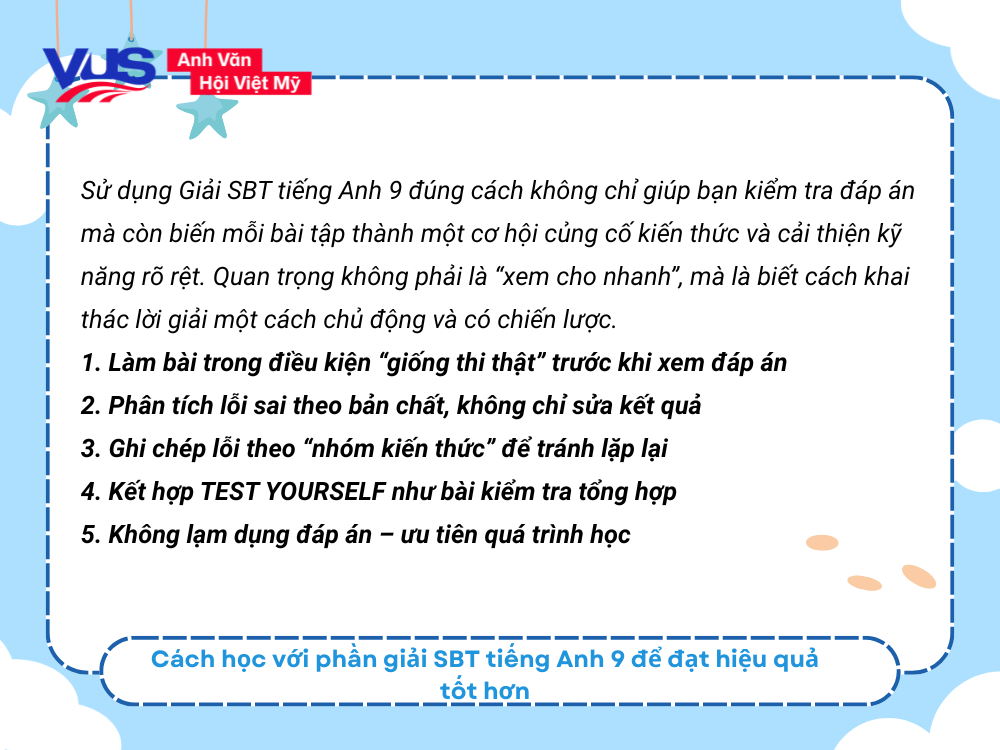
Sử dụng Giải SBT tiếng Anh 9 đúng cách không chỉ giúp bạn kiểm tra đáp án mà còn biến mỗi bài tập thành một cơ hội củng cố kiến thức và cải thiện kỹ năng rõ rệt. Quan trọng không phải là “xem cho nhanh”, mà là biết cách khai thác lời giải một cách chủ động và có chiến lược.
1. Làm bài trong điều kiện “giống thi thật” trước khi xem đáp án
Thay vì làm qua loa, hãy đặt thời gian cụ thể cho từng dạng bài (ví dụ: 10–15 phút cho phần Vocabulary & Grammar). Điều này giúp bạn rèn phản xạ và kiểm tra đúng năng lực hiện tại.
Ví dụ: Khi làm câu chia động từ:
→ She (go) to school yesterday.
Bạn cần tự xác định “yesterday” → thì quá khứ → went, thay vì nhìn đáp án rồi chép lại.
Sau khi làm xong, hãy kiểm tra từng phần (Pronunciation → Grammar → Reading…). Cách này giúp bạn nhận ra mình yếu ở kỹ năng nào, thay vì chỉ biết “sai nhiều”.
2. Phân tích lỗi sai theo bản chất, không chỉ sửa kết quả: Đây là bước quan trọng nhất nhưng thường bị bỏ qua. Với mỗi câu sai, hãy tự hỏi:
- Sai do từ vựng (không hiểu nghĩa)?
- Sai do ngữ pháp (nhầm thì, cấu trúc)?
- Hay sai do đọc hiểu (hiểu sai ngữ cảnh)?
Ví dụ:
→ Câu đúng: He has lived here for 5 years.
Nếu bạn làm sai thành He lived here for 5 years, vấn đề không phải chia sai “ngẫu nhiên” mà là chưa nắm rõ cách dùng thì hiện tại hoàn thành với “for”.
3. Ghi chép lỗi theo “nhóm kiến thức” để tránh lặp lại: Thay vì ghi rời rạc, hãy gom lỗi thành từng nhóm như:
- Thì động từ (tenses): Xác định sai dấu hiệu thời gian hoặc bản chất hành động (đã kết thúc, đang diễn ra, hay còn liên quan đến hiện tại), dẫn đến chia sai thì. Ví dụ: I have finished my homework already (không dùng quá khứ đơn với “already”).
- Giới từ (prepositions): Dùng sai do dịch từng từ từ tiếng Việt thay vì học theo cụm cố định. Ví dụ: good at English (không dùng good in), interested in, depend on.
- Cấu trúc câu (sentence structures): Nhầm lẫn công thức hoặc kết hợp sai các cấu trúc tương tự nhau. Ví dụ: too…to + V (không dùng too…that), although… không đi kèm but.
Cách này giúp bạn nhìn ra “pattern lỗi sai” của bản thân. Ví dụ: nếu liên tục sai về present perfect, bạn biết mình cần ôn lại chuyên sâu phần đó.
4. Kết hợp TEST YOURSELF như bài kiểm tra tổng hợp: Sau mỗi 3 Unit, hãy làm TEST YOURSELF trong điều kiện nghiêm túc (giới hạn thời gian, không tra tài liệu). Đây là cách tốt nhất để:
- Đánh giá mức độ tiến bộ
- Làm quen cấu trúc đề thi
- Phát hiện lỗ hổng kiến thức theo “mảng lớn”
5. Không lạm dụng đáp án – ưu tiên quá trình học: Nhiều bạn có thói quen “xem để biết” nhưng không học được gì. Hãy nhớ: Giá trị của tài liệu không nằm ở đáp án đúng, mà nằm ở quá trình bạn tự sai → hiểu sai → sửa sai → không sai nữa.
Tóm lại, Giải SBT tiếng Anh 9 không chỉ đơn thuần là tài liệu cung cấp đáp án mà còn là công cụ hỗ trợ học tập cực kỳ hiệu quả nếu bạn biết cách khai thác đúng.
Từ việc hệ thống kiến thức theo từng Unit, luyện tập qua các dạng bài đa dạng đến tự đánh giá với TEST YOURSELF, tất cả đều góp phần giúp bạn củng cố nền tảng và cải thiện kỹ năng một cách rõ rệt.
Khi kết hợp với phương pháp học chủ động và phân tích lỗi sai khoa học, bạn hoàn toàn có thể biến quá trình làm bài tập thành bước đệm vững chắc để nâng cao điểm số và tự tin hơn trong các kỳ thi quan trọng.
Câu hỏi thường gặp về giải SBT tiếng Anh 9
-
Giải SBT tiếng Anh 9 có bám sát chương trình trên lớp không?
Có. Nội dung được xây dựng theo từng Unit trong sách Global Success, đảm bảo bám sát cấu trúc bài học trên lớp. Các dạng bài tập, từ vựng và ngữ pháp đều tương ứng với chương trình chính khóa, giúp học sinh dễ dàng đối chiếu và ôn tập đúng trọng tâm mà không bị lệch kiến thức. -
Nên làm bài trước hay xem đáp án trước?
Bạn nên làm bài trước để kiểm tra năng lực thực tế, sau đó mới đối chiếu đáp án. Nếu xem trước, bạn sẽ dễ rơi vào tình trạng học thụ động và không nhận ra lỗi sai của mình. Việc tự làm trước giúp phát hiện điểm yếu rõ ràng hơn và cải thiện hiệu quả. -
Làm sao để sử dụng giải SBT tiếng Anh 9 không bị phụ thuộc?
Hãy chỉ sử dụng tài liệu như công cụ kiểm tra, không phải “nguồn học chính”. Sau khi làm bài, chỉ xem những câu sai hoặc chưa chắc chắn, đồng thời ghi chú lại lỗi theo từng nhóm kiến thức. Cách này giúp bạn học chủ động và tránh phụ thuộc vào đáp án.
100% giáo viên tại VUS sở hữu chứng chỉ giảng dạy tiếng Anh Quốc tế (TESOL, CELTA,…). VUS tiên phong phát triển phương pháp giảng dạy Discovery Learning (Học Thông Qua Khám Phá) được phát triển dựa trên triết lý giáo dục Constructivism (Kiến tạo) – nơi học viên không chỉ học một ngôn ngữ, mà còn học cách tư duy, phản biện và làm chủ tri thức.
Vui lòng để lại thông tin phía dưới để được tư vấn miễn phí
Phạm Việt Thục Đoan
IELTS
8.5
Doãn Bá Khánh Nguyên
IELTS
8.5
Nguyễn Lê Huy
IELTS
8.0
Võ Ngọc Bảo Trân
IELTS
8.0
Nguyễn Đăng Minh Hiển
144
KET
Ngô Nguyễn Bảo Nghi
143
KET
Đỗ Huỳnh Gia Hân
Starters
15
Khiên
Võ Nguyễn Bảo Ngọc
Starters
15
Khiên
Nguyễn Võ Minh Khôi
Movers
15
Khiên
Nguyễn Đặng Nhã Trúc
Starters
15
Khiên
Môi trường học tập
chuẩn Quốc tế
Cơ sở vật chất, giáo viên và chứng nhận từ đối tác quốc tế mang đến môi trường giáo dục tiếng Anh hàng đầu với trải nghiệm học tập tốt nhất cho học viên.
Vui lòng để lại thông tin phía dưới để được tư vấn miễn phí
