


Soạn Tiếng Anh 6 Unit 8 Global Success (có đáp án chi tiết)
Tiếng Anh 6 Unit 8 Global Success – Sports and Games là một trong những bài học quan trọng giúp học sinh mở rộng vốn từ vựng về thể thao, rèn luyện ngữ pháp giao tiếp và phát triển đồng thời cả bốn kỹ năng nghe – nói – đọc – viết.
Tuy nhiên, với lượng kiến thức khá dày cùng nhiều dạng bài mới, không ít bạn gặp khó khăn khi tự soạn bài và kiểm tra đáp án.
Trong bài viết này, bạn sẽ được:
- Tổng hợp đầy đủ từ vựng và ngữ pháp cốt lõi của tiếng Anh 6 Unit 8 theo bảng dễ học – dễ tra cứu.
- Soạn chi tiết từng phần Getting Started, A Closer Look 1, 2, Communication, Skills 1, 2, Looking Back, Project kèm giải thích rõ ràng.
- Luyện tập với bài tập thực hành có đáp án giúp ôn tập nhanh, hiểu sâu và ghi nhớ hiệu quả.
Table of Contents
Tổng hợp từ vựng Tiếng Anh 6 Unit 8
Phần tổng hợp từ vựng Tiếng Anh 6 Unit 8 dưới đây sẽ giúp bạn nắm trọn các từ mới quan trọng về chủ đề Sports and Games một cách hệ thống và dễ ghi nhớ.
Mỗi từ đều được trình bày kèm từ loại, nghĩa tiếng Việt và ví dụ minh họa, hỗ trợ bạn học nhanh – nhớ lâu – áp dụng đúng trong bài tập và giao tiếp.
|
STT |
Từ tiếng Anh |
Từ loại |
Nghĩa tiếng Việt |
Ví dụ |
|
1 |
gym |
noun |
phòng tập thể dục |
This gym is very big. |
|
2 |
equipment |
noun |
thiết bị (tập luyện) |
The gym has a lot of new equipment. |
|
3 |
sports |
noun |
thể thao |
I love playing sports. |
|
4 |
karate |
noun |
võ karate |
I learn karate after school. |
|
5 |
table tennis |
noun |
bóng bàn |
I play table tennis with my friends. |
|
6 |
win |
verb |
chiến thắng |
Duong played with Duy and won. |
|
7 |
good |
adjective |
giỏi, tốt |
He is very good at sports. |
|
8 |
idea |
noun |
ý tưởng |
That’s a good idea. |
|
9 |
club |
noun |
câu lạc bộ |
I join the karate club. |
|
10 |
can |
modal verb |
có thể |
I can swim very well. |
|
11 |
meet |
verb |
gặp gỡ |
I’ll meet you on Sunday. |
|
12 |
super fit |
adjective |
rất khỏe |
He is super fit and active. |
|
13 |
swim |
verb |
bơi |
Can you swim? |
|
14 |
outdoors |
adverb |
ngoài trời |
I play sports outdoors. |
|
15 |
exercise |
noun / verb |
bài tập / tập luyện |
I do morning exercise every day. |
|
16 |
break time |
noun |
giờ ra chơi |
We play football at break time. |
|
17 |
schoolyard |
noun |
sân trường |
Students play in the schoolyard. |
|
18 |
game |
noun |
trò chơi |
Football is an exciting game. |
|
19 |
volleyball |
noun |
bóng chuyền |
She plays volleyball after school. |
|
20 |
chess |
noun |
cờ vua |
I play chess with my grandpa. |
|
21 |
aerobics |
noun |
thể dục nhịp điệu |
My mum does aerobics every morning. |
|
22 |
international |
adjective |
quốc tế |
She won an international competition. |
|
23 |
world |
noun |
thế giới |
He is famous in the world. |
|
24 |
competition |
noun |
cuộc thi |
She won the sports competition. |
|
25 |
champion |
noun |
nhà vô địch |
He became a world champion. |
|
26 |
contest |
noun |
cuộc thi |
Can you send my congratulations to the winner of the contest? |
|
27 |
winner |
noun |
người chiến thắng |
She is the winner of the match. |
|
28 |
racket |
noun |
vợt |
Please get the racket for me. |
|
29 |
match |
noun |
trận đấu |
We watched an exciting match. |
|
30 |
goggles |
noun |
kính bơi |
Don’t forget your goggles. |
|
31 |
boat |
noun |
thuyền |
They go boating on the lake. |
|
32 |
grandpa |
noun |
ông |
My grandpa is old but active. |
|
33 |
badminton |
noun |
cầu lông |
I played badminton yesterday. |
|
34 |
bicycle |
noun |
xe đạp |
I go to school by bicycle. |
|
35 |
weekend |
noun |
cuối tuần |
What do you do at the weekend? |
|
36 |
fishing |
noun |
câu cá |
My dad goes fishing on Sunday. |
|
37 |
museum |
noun |
bảo tàng |
We visited a museum last weekend. |
|
38 |
restaurant |
noun |
nhà hàng |
We had dinner at a restaurant. |
|
39 |
football |
noun |
bóng đá |
I play football with my classmates. |
|
40 |
score |
verb / noun |
ghi bàn / điểm số |
He scored a fantastic goal. |
|
41 |
exhausted |
adjective |
kiệt sức |
I was exhausted after the match. |
|
42 |
sleep |
verb |
ngủ |
I sleep early on school days. |
|
43 |
gum |
noun |
kẹo cao su |
Don’t chew gum in class. |
|
44 |
windy |
adjective |
nhiều gió |
It is windy today. |
|
45 |
tidy up |
phrasal verb |
dọn dẹp |
Please tidy up your room. |
|
46 |
loudly |
adverb |
to, lớn |
Don’t speak loudly in class. |
|
47 |
fire |
noun |
lửa |
Be careful with fire. |
|
48 |
free time |
noun phrase |
thời gian rảnh |
I play sports in my free time. |
|
49 |
often |
adverb |
thường xuyên |
I often play football after school. |
|
50 |
join |
verb |
tham gia |
I want to join the sports club. |
|
51 |
congratulation(s) |
noun |
lời chúc mừng |
Congratulations on your win! |
|
52 |
player |
noun |
cầu thủ / người chơi |
He is a good football player. |
|
53 |
marathon |
noun |
cuộc chạy marathon |
The first marathon took place in 1896. |
|
54 |
bear |
noun |
con gấu |
We saw a bear at the zoo. |
|
55 |
goal |
noun |
bàn thắng |
That was a great goal. |
|
56 |
call |
verb |
gọi |
I will call you tonight. |
|
57 |
special |
adjective |
đặc biệt |
Today is a special day. |
|
58 |
footballer |
noun |
cầu thủ bóng đá |
He wants to be a footballer. |
|
59 |
career |
noun |
sự nghiệp |
He has a great sports career. |
|
60 |
amazing |
adjective |
tuyệt vời |
That match was amazing. |
|
61 |
famous |
adjective |
nổi tiếng |
He is a famous footballer. |
|
62 |
passenger |
noun |
hành khách |
The passengers are on the boat. |
|
63 |
noise |
noun |
tiếng ồn |
There is a lot of noise here. |
|
64 |
intelligent |
adjective |
thông minh |
She is very intelligent. |
|
65 |
touch |
verb |
chạm |
Don’t touch the ball. |
|
66 |
important |
adjective |
quan trọng |
Exercise is important for health. |
|
67 |
stadium |
noun |
sân vận động |
The match is at the stadium. |
|
68 |
newspaper |
noun |
báo |
My dad reads the newspaper. |
|
69 |
skipping rope |
noun phrase |
nhảy dây |
I like skipping rope. |
|
70 |
wrestling |
noun |
đấu vật |
Wrestling is a strong sport. |
Xem thêm: Bộ từ vựng tiếng Anh lớp 6 theo Unit [CHƯƠNG TRÌNH MỚI]
Ngữ pháp cốt lõi trong Tiếng Anh 6 Unit 8
Trong Tiếng Anh 6 Unit 8: Sports and Games, học sinh được làm quen với 2 điểm ngữ pháp trọng tâm xuyên suốt các hoạt động Listening – Speaking – Writing, bao gồm Thì quá khứ đơn (Past Simple) và Câu mệnh lệnh (Imperatives).
Đây đều là những cấu trúc nền tảng, xuất hiện trực tiếp trong hội thoại, bài tập và phần Language Focus của SGK.
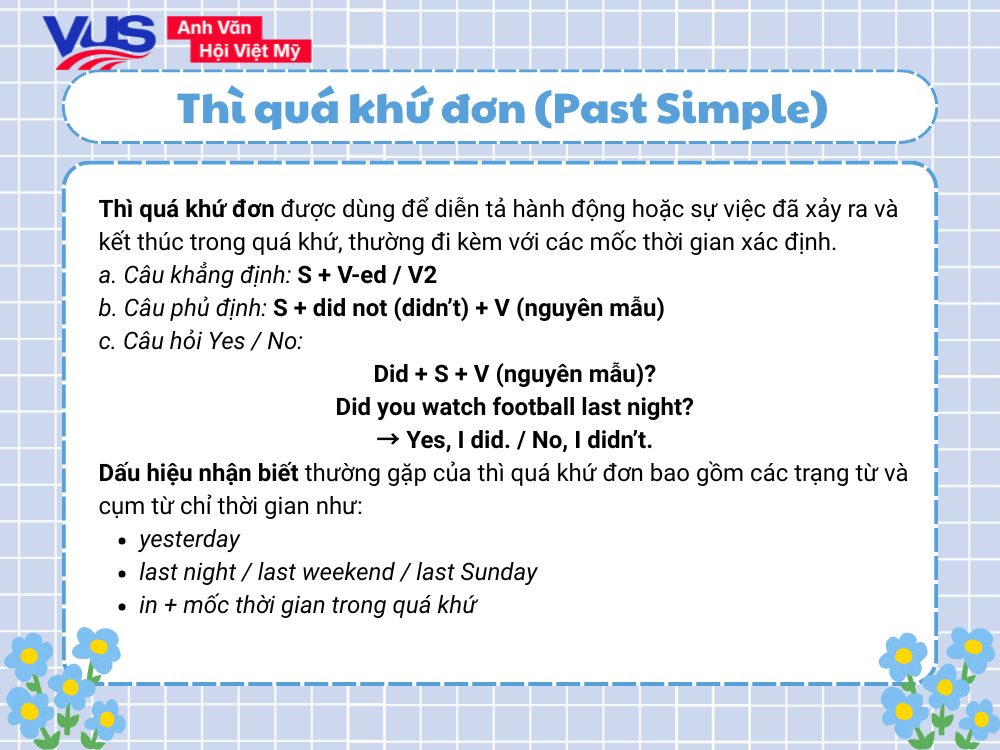
1. Thì quá khứ đơn (Past Simple)
Thì quá khứ đơn được dùng để diễn tả hành động hoặc sự việc đã xảy ra và kết thúc trong quá khứ, thường đi kèm với các mốc thời gian xác định. Thì quá khứ đơn thường được sử dụng để:
- Kể lại các hoạt động đã diễn ra
- Hỏi – đáp về sự việc trong quá khứ
- Nói về kết quả của một hành động
a. Câu khẳng định:
S + V-ed / V2
Ví dụ: I played badminton yesterday.
b. Câu phủ định:
S + did not (didn’t) + V (nguyên mẫu)
Ví dụ: I didn’t play football last Sunday.
c. Câu hỏi Yes / No:
Did + S + V (nguyên mẫu)?
Did you watch football last night?
→ Yes, I did. / No, I didn’t.
Dấu hiệu nhận biết thường gặp của thì quá khứ đơn bao gồm các trạng từ và cụm từ chỉ thời gian như:
- yesterday
- last night / last weekend / last Sunday
- in + mốc thời gian trong quá khứ
Lưu ý: Sau did / didn’t, động từ luôn ở dạng nguyên mẫu.
2. Câu mệnh lệnh (Imperatives)
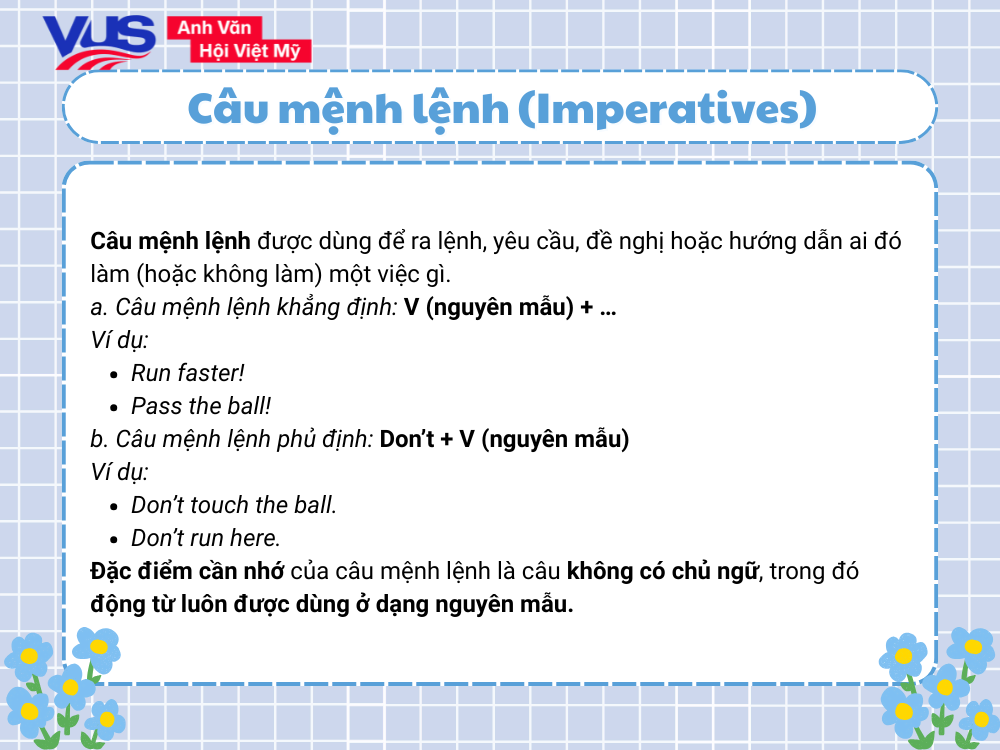
Câu mệnh lệnh được dùng để ra lệnh, yêu cầu, đề nghị hoặc hướng dẫn ai đó làm (hoặc không làm) một việc gì. Câu mệnh lệnh thường dùng khi:
- Hướng dẫn cách làm một việc
- Đưa ra yêu cầu ngắn gọn
- Nhắc nhở hoặc cảnh báo
a. Câu mệnh lệnh khẳng định:
V (nguyên mẫu) + …
Ví dụ:
- Run faster!
- Pass the ball!
b. Câu mệnh lệnh phủ định:
Don’t + V (nguyên mẫu)
Ví dụ:
- Don’t touch the ball.
- Don’t run here.
Đặc điểm cần nhớ của câu mệnh lệnh là câu không có chủ ngữ, trong đó động từ luôn được dùng ở dạng nguyên mẫu.
Cấu trúc câu thường ngắn gọn, rõ ràng, giúp người nói đưa ra yêu cầu, hướng dẫn hoặc nhắc nhở một cách trực tiếp và dễ hiểu trong giao tiếp hằng ngày.
Xem thêm: Tổng hợp ngữ pháp tiếng Anh lớp 6 Global Success
Soạn bài chi tiết Tiếng Anh 6 Unit 8 Global Success Sports and Games từng phần
Phần Soạn bài Tiếng Anh 6 Unit 8 Global Success được xây dựng nhằm hỗ trợ học sinh nắm chắc toàn bộ kiến thức trọng tâm của bài học theo đúng cấu trúc SGK, giúp việc ôn tập và làm bài trên lớp trở nên dễ dàng, hệ thống và hiệu quả hơn.
Nội dung soạn bài được trình bày theo từng phần cụ thể, bám sát thứ tự trong sách học sinh, bao gồm từ vựng – ngữ pháp – kỹ năng đọc, nghe, nói, viết và hoạt động vận dụng cuối bài.
Tiếng Anh 6 Unit 8 Getting Started
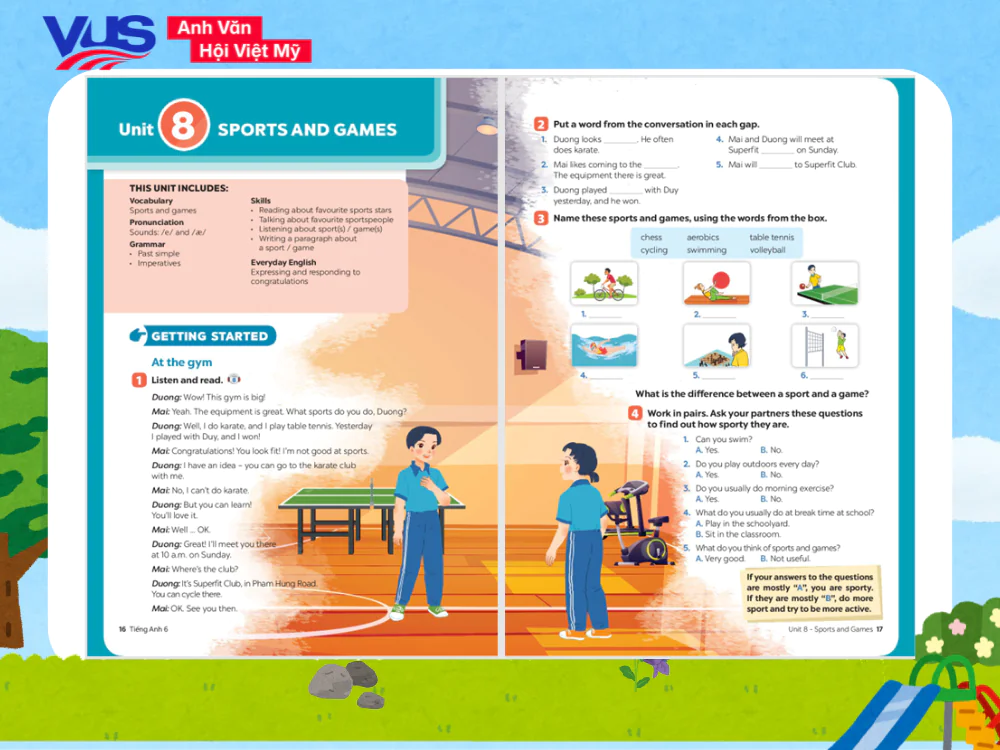
At the gym
1. Listen and read. (Học sinh thực hiện theo hướng dẫn của giáo viên)
2. Put a word from the conversation in each gap.
- Duong looks ________. He often does karate.
- Mai likes coming to the ________. The equipment there is great.
- Duong played ________ with Duy yesterday, and he won.
- Mai and Duong will meet at Superfit ________ on Sunday.
- Mai will ________ to Superfit Club.
Đáp án:
1. fit 2. gym 3. table tennis 4. Club 5. cycle
3. Name these sports and games, using the words from the box.
Words: chess – aerobics – table tennis – cycling – swimming – volleyball
Đáp án:
1. cycling 2. aerobics 3. table tennis 4. swimming 5. chess 6. volleyball
What is the difference between a sport and a game?
4. Work in pairs. Ask your partners these questions to find out how sporty they are.
- Can you swim?
A. Yes. B. No. - Do you play outdoors every day?
A. Yes. B. No. - Do you usually do morning exercise?
A. Yes. B. No. - What do you usually do at break time at school?
A. Play in the schoolyard.
B. Sit in the classroom. - What do you think of sports and games?
A. Very good.
B. Not useful.
If your answers to the questions are mostly “A”, you are sporty.
If they are mostly “B”, do more sport and try to be more active.
(Học sinh thực hiện theo hướng dẫn của giáo viên)
Tiếng Anh 6 Unit 8 A Closer Look 1
Vocabulary
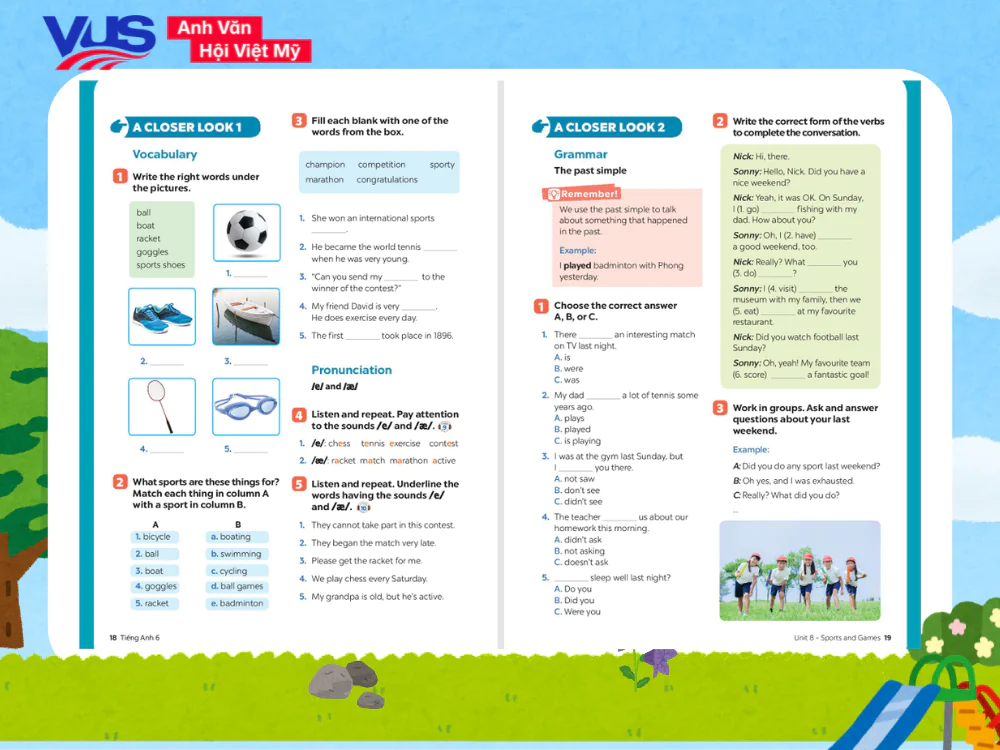
1. Write the right words under the pictures.
Words: ball – boat – racket – goggles – sports shoes
Đáp án:
1. ball 2. sports shoes 3. boat 4. racket 5. goggles
2. What sports are these things for?
Match each thing in column A with a sport in column B.
A
- bicycle
- ball
- boat
- goggles
- racket
B
a. boating
b. swimming
c. cycling
d. ball games
e. badminton
Đáp án:
1. c 2. d 3. a 4. b 5. e
3. Fill each blank with one of the words from the box.
Words: champion – competition – sporty – marathon – congratulations
- She won an international sports ________.
- He became the world tennis ________ when he was very young.
- “Can you send my ________ to the winner of the contest?”
- My friend David is very ________. He does exercise every day.
- The first ________ took place in 1896.
Đáp án:
1. competition 2. champion 3. congratulations 4. sporty 5. marathon
Pronunciation /e/ and /æ/
4. Listen and repeat.
Audio script:
/e/: chess tennis exercise contest
/æ/: racket match marathon active
5. Listen and repeat. Underline the words having the sounds /e/ and /æ/.
- They cannot take part in this contest.
- They began the match very late.
- Please get the racket for me.
- We play chess every Saturday.
- My grandpa is old, but he’s active.
Key + Audio script:
- They cannot take part in this contest.
- They began the match very late.
- Please get the racket for me.
- We play chess every Saturday.
- My grandpa is old, but he’s active.
Tiếng Anh 6 Unit 8 A Closer Look 2
Grammar
The past simple
Remember!
We use the past simple to talk about something that happened in the past.
Example:
I played badminton with Phong yesterday.
1. Choose the correct answer A, B, or C.
- There ______ an interesting match on TV last night.
A. is
B. were
C. was - My dad ______ a lot of tennis some years ago.
A. plays
B. played
C. is playing - I was at the gym last Sunday, but Anna ______ you there.
A. not saw
B. don’t see
C. didn’t see - The teacher ______ us about our homework this morning.
A. didn’t ask
B. not asking
C. doesn’t ask - ______ you sleep well last night?
A. Do
B. Did
C. Were
Đáp án:
- C
- B
- C
- A
- B
2. Write the correct form of the verbs to complete the conversation.
Nick: Hi, there.
Sonny: Hello Nick. Did you have a nice weekend?
Nick: Yeah, it was OK. On Sunday, I (1. go) __________ fishing with my dad. How about you?
Sonny: Oh, I (2. have) __________ a good weekend, too.
Nick: Really? What (3. do) __________ you do?
Sonny: I (4. visit) __________ the museum with my family, then we (5. eat) __________ at my favourite restaurant.
Nick: Did you watch football last Sunday?
Sonny: Oh, yeah! My favourite team (6. score) __________ a fantastic goal!
Đáp án:
- went
- had
- did you do
- visited
- ate
- scored
3. Work in groups. Ask and answer questions about your last weekend.
Example:
A: Did you do any sport last weekend?
B: Oh yes, and I was exhausted.
C: Really? What did you do?
(Học sinh thực hiện theo hướng dẫn của giáo viên)
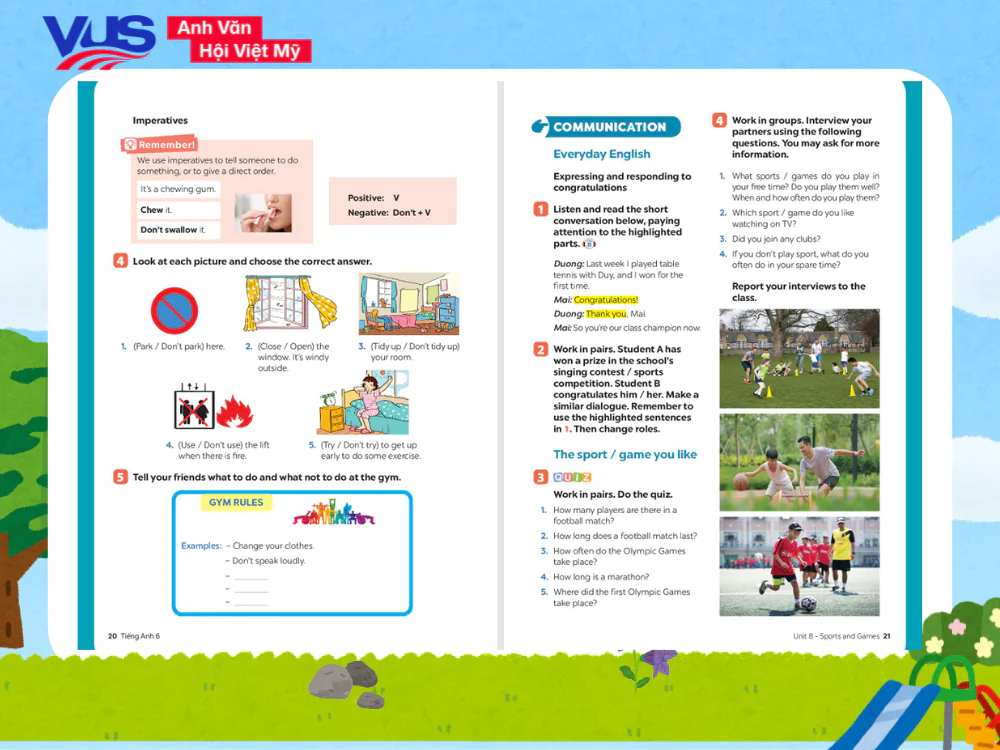
Imperatives
Remember!
We use imperatives to tell someone to do something, or to give a direct order.
It’s a chewing gum.
Chew it.
Don’t swallow it.
Form:
- Positive: V
- Negative: Don’t + V
4. Look at each picture and choose the correct answer.
- (Park / Don’t park) here.
- (Close / Open) the window. It’s windy outside.
- (Tidy up / Don’t tidy up) your room.
- (Use / Don’t use) the lift when there is fire.
- (Try / Don’t try) to get up early to do some exercise.
Đáp án:
- Don’t park
- Close
- Tidy up
- Don’t use
- Try
5. Tell your friends what to do and what not to do at the gym.
GYM RULES
Examples:
- Change your clothes.
- Don’t speak loudly.
Đáp án (tham khảo):
- Change your clothes.
- Don’t speak loudly.
- Warm up before exercising.
- Don’t run inside the gym.
- Clean the equipment after using it.
- Don’t eat or drink in the gym.
Tiếng Anh 6 Unit 8 Communication
Everyday English
Expressing and responding to congratulations
1. Listen and read the short conversation below, paying attention to the highlighted parts.
(Học sinh thực hiện theo hướng dẫn của giáo viên)
2. Work in pairs. Student A has won a prize in the school’s singing contest / sports competition. Student B congratulates him / her. Make a simple dialogue. Remember to use the highlighted sentences in 1. Then change roles.
Đáp án (tham khảo):
a. Dialogue 1 – Sports competition
Student A: Hi! I won first prize in the school football competition yesterday.
Student B: Congratulations!
Student A: Thank you.
Student B: So you’re the school champion now.
Student A: Yes, I’m very happy.
b. Dialogue 2 – Singing contest (change roles)
Student B: Guess what! I won a prize in the school singing contest.
Student A: Congratulations!
Student B: Thank you very much.
Student A: You sing really well.
Student B: Thanks!
The sport / game you like
3. Work in pairs. Do the quiz.
- How many players are there in a football match?
- How long does a football match last?
- How often do the Olympic Games take place?
- How long is a marathon?
- Where did the first Olympic Games take place?
Đáp án:
- There are usually 22 players (11 on each side).
- It normally lasts 90 minutes (divided into two halves).
- They take place every four years.
- A marathon is 42.195 kilometers long (26 miles and 385 yards).
- They took place in Olympia in Ancient Greece (in 776 BC).
4. Work in groups. Interview your partners using the following questions. You may ask for more information.
- What sports / games do you play in your free time? Do you play them well? When and how often do you play them?
- Which sport / game do you like watching on TV?
- Did you join any clubs?
- If you don’t play sport, what do you often do in your spare time?
Report your interviews to the class.
Đáp án (tham khảo):
Interview
Student A: What sports do you play in your free time?
Student B: I play football and badminton. I play them quite well. I usually play after school, three times a week.
Student A: Which sport do you like watching on TV?
Student B: I like watching football on TV.
Student A: Did you join any clubs?
Student B: Yes, I joined the school football club.
Report to the class
Student A reports:
My friend plays football and badminton in his free time. He plays after school three times a week. He likes watching football on TV and he joined the school football club.
Tiếng Anh 6 Unit 8 Skills 1
Reading
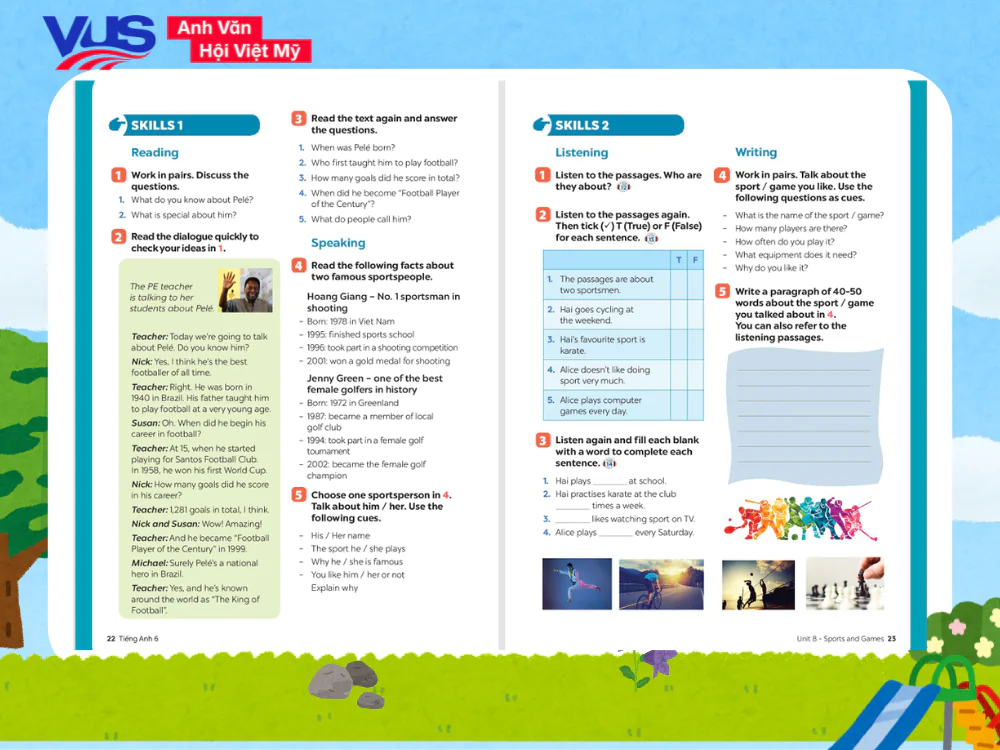
1. Work in pairs. Discuss the questions.
- What do you know about Pelé?
- What is special about him?
Đáp án (tham khảo):
- Pelé is a famous football player from Brazil. He started playing football when he was very young. He scored many goals in his career.
- He is special because he is one of the best football players of all time. People call him “The King of Football”.
2. Read the dialogue quickly to check your ideas in 1.
Ví dụ:
- … best footballer
- … from Brazil
- … won the World Cup
- … the King of Football
3. Read the text again and answer the questions.
- When was Pelé born?
- Who first taught him to play football?
- How many goals did he score in total?
- When did he become “Football Player of the Century”?
- What do people call him?
Đáp án:
- Pelé was born in 1940.
- His father did. / His father taught him.
- He scored 1,281 goals in total.
- (He became Football Player of the Century in 1999.)
Speaking
4. Read the following facts about two famous sportspeople. (Học sinh thực hiện theo hướng dẫn của giáo viên)
5. Choose one sportsperson in 4. Talk about him / her. Use the following cues.
- His / Her name
- The sport he / she plays
- Why he / she is famous
- You like him / her or not
- Explain why
Đáp án (tham khảo):
His name is Hoang Giang.
He plays shooting.
He is famous because he won a gold medal in shooting in 2001.
I like him because he is very talented and works hard.
Tiếng Anh 6 Unit 8 Skills 2
Listening
1. Listen to the passages. Who are they about?
Đáp án: The listening passages are about Hai and Alice.
2. Listen to the passages again. Then tick (✓) T (True) or F (False) for each sentence.
|
Statements |
T |
F |
|
|
1. |
The passages are about two sportsmen. |
✓ |
|
|
2. |
Hai goes cycling at the weekend. |
✓ |
|
|
3. |
Hai’s favourite sport is karate. |
✓ |
|
|
4. |
Alice doesn’t like doing sport very much. |
✓ |
|
|
5. |
Alice plays computer games every day. |
✓ |
3. Listen again and fill each blank with a word to complete each sentence.
- Hai plays ______ at school.
- Hai practises karate at the club ______ times a week.
- ______ likes watching sport on TV.
- Alice plays ______ every Saturday.
Đáp án:
- volleyball
- three
- Alice
- chess
Audio script:
Hello. My name’s Hai. I love sport. I play volleyball at school and I often go cycling with my dad at the weekend. But my favourite sport is karate. I practise it three times a week. It makes me strong and confident.
My name’s Alice. I’m twelve years old. I don’t like doing sport very much, but I like watching sport on TV. My hobby is playing chess. My friend and I play chess every Saturday. I sometimes play computer games, too. I hope to create a new computer game one day.
Writing
4. Work in pairs. Talk about the sport / game you like. Use the following questions as cues.
- What is the name of the sport / game?
- How many players are there?
- How often do you play it?
- What equipment does it need?
- Why do you like it?
Đáp án (tham khảo):
The sport I like is football.
There are two teams with eleven players in each team.
I play it after school three times a week.
It needs a ball and a football field.
I like it because it is fun and good for my health.
5. Write a paragraph of 40–50 words about the sport / game you talked about in 4.
You can also refer to the listening passages.
Ví dụ:
- Football is my favourite sport. There are two teams with eleven players in each team. I often play football after school with my friends. It needs a ball and a large field. I like football because it is fun and helps me stay healthy.
- Badminton is my favourite game. There are two players in a match. I usually play it at the weekend with my sister. It needs a racket and a shuttlecock. I like badminton because it is easy to play and good for my health.
Tiếng Anh 6 Unit 8 Looking Back
Vocabulary
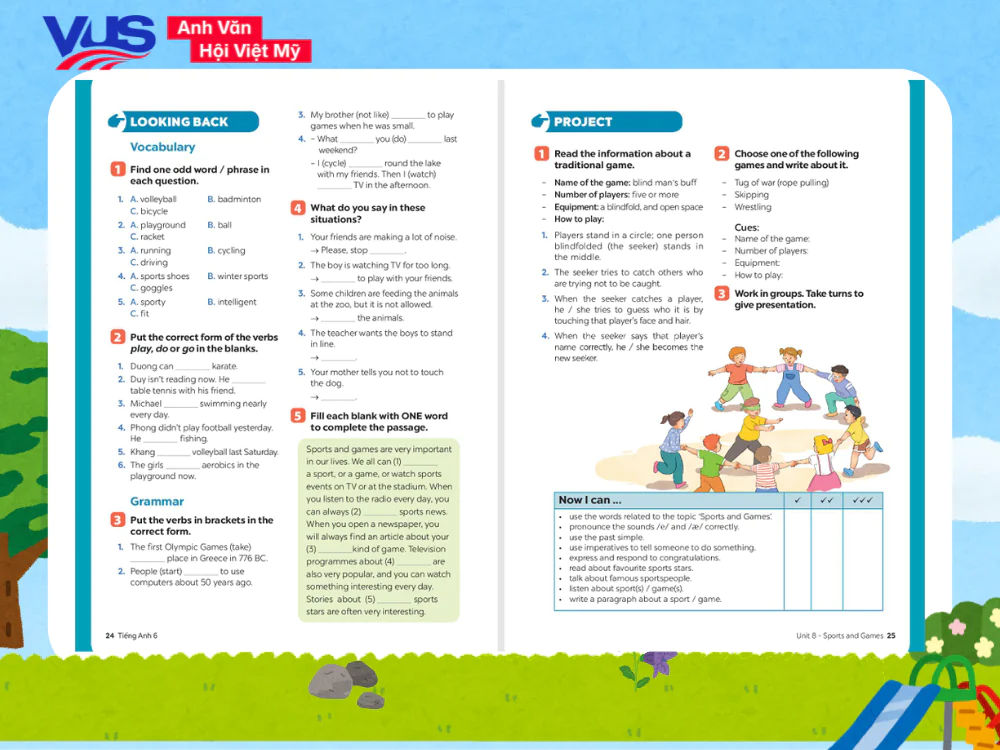
1. Find one odd word / phrase in each question.
- A. volleyball B. badminton
- A. bicycle B. ball
- A. playground B. rackets
- A. running B. cycling
- A. sports shoes B. winter sports
Đáp án:
- C
- A
- C
- B
- B
2. Put the correct form of the verbs play, do or go in the blanks.
- Duong can ______ karate.
- Duy isn’t reading now. He ______ table tennis with his friend.
- Michael ______ swimming nearly every day.
- Phong didn’t play football yesterday. He ______ fishing.
- Khang ______ volleyball last Saturday.
- The girls ______ aerobics in the playground now.
Đáp án:
- do
- is playing
- goes
- went
- played
- are doing
Grammar
3. Put the verbs in brackets in the correct form.
- The first Olympic Games (take) ______ place in Greece in 776 BC.
- People (start) ______ to use computers about 50 years ago.
- My brother (not like) ______ to play games when he was small.
- – What ______ you (do) ______ last weekend?
– I (cycle) ______ round the lake with my friends. Then I (watch) ______ TV in the afternoon.
Đáp án:
- took
- started
- didn’t like
- did you do; cycled; watched
4. What do you say in these situations?
- Your friends are making a lot of noise.
→ Please, stop ______. - The boy is watching TV for too long.
→ ______ to play with your friends. - Some children are feeding the animals at the zoo, but it is not allowed.
→ ______ the animals. - The teacher wants the boys to stand in line.
→ ______. - Your mother tells you not to touch the dog.
→ ______.
Đáp án:
- Please stop making noise.
- Go out to play with your friends.
- Don’t feed the animals.
- Stand in line, boys!
- Don’t touch the dog.
5. Fill each blank with ONE word to complete the passage.
Sports and games are very important in our lives. We all can (1) ______ a sport, or a game, or watch sports events on TV or at the stadium. When you listen to the radio every day, you can always (2) ______ sports news. When you open a newspaper, you will always find an article about your (3) ______ kind of game. Television programmes about (4) ______ are also very popular, and you can watch something interesting every day. Stories about (5) ______ sports stars are often very interesting.
Đáp án:
- play
- hear
- favourite
- sports
- famous
Tiếng Anh 6 Unit 8 Project
1. Read the information about a traditional game.
- Name of the game: blind man’s bluff
- Number of players: five or more
- Equipment: a blindfold, and open space
How to play:
- Players stand in a circle; one person blindfolded (the seeker) stands in the middle.
- The seeker tries to catch others who are trying not to be caught.
- When the seeker catches a player, he / she tries to guess who it is by touching that player’s face and hair.
- When the seeker says that player’s name correctly, he / she becomes the new seeker.
(Học sinh thực hiện theo hướng dẫn của giáo viên)
2. Choose one of the following games and write about it.
- Tug of war (rope pulling)
- Skipping
- Wrestling
Cues:
- Name of the game
- Number of players
- Equipment
- How to play
Đáp án (tham khảo):
- Name of the game: Tug of war
- Number of players: Two teams, with five or more players in each team
- Equipment: A long rope and an open space
- How to play: Players stand in two teams and hold the rope. When the game starts, both teams pull the rope. The team that pulls the rope over the line wins the game.
3. Work in groups. Take turns to give presentation.
Now I can …
- use the words related to the topic Sports and Games.
- pronounce the sounds /e/ and /æ/ correctly.
- use the past simple.
- use imperatives to tell someone to do something.
- express and respond to congratulations.
- read about favourite sports stars.
- talk about famous sportspeople.
- listen about sports / games.
- write a paragraph about a sport / game.
Đáp án (tham khảo):
Today, I would like to talk about sports and games.
Sports and games are very important in our lives. I like football best because it is fun and good for my health. I often play football with my friends after school.
I also know some famous sportspeople like Pelé. He is called “The King of Football”.
I enjoy learning this unit because I can talk more confidently about sports and games.
Qua Tiếng Anh 6 Unit 8 Sports and Games, có thể thấy học sinh không chỉ học từ vựng và ngữ pháp riêng lẻ, mà còn bắt đầu phải vận dụng tiếng Anh trong ngữ cảnh giao tiếp thực tế:
- Nói về thói quen thể thao
- Kể lại hoạt động đã diễn ra (Past Simple)
- Đưa ra yêu cầu, hướng dẫn (Imperatives)
- Trình bày ý kiến cá nhân khi nói – viết
Tuy nhiên, khó khăn phổ biến của nhiều học sinh lớp 6 là:
- Làm được bài tập trong sách nhưng chưa tự tin nói và viết ngoài khuôn mẫu
- Nhớ cấu trúc nhưng dùng sai ngữ cảnh khi giao tiếp
- Học xong từng Unit nhưng chưa hình thành phản xạ tiếng Anh liền mạch
Đây cũng là giai đoạn “bản lề” khi học sinh chuyển từ học tiếng Anh theo dạng nhận biết sang dùng tiếng Anh như một công cụ giao tiếp – tư duy.
Vì sao học sinh cần một lộ trình tiếng Anh bài bản hơn sau lớp 6?
Khi chương trình Global Success lên cấp THCS, yêu cầu không còn dừng ở việc:
- Chọn đáp án đúng
- Điền từ phù hợp
Mà chuyển sang:
- Diễn đạt ý kiến cá nhân rõ ràng
- Phát triển kỹ năng nói – viết song song
- Sử dụng tiếng Anh để thuyết trình, làm việc nhóm, phản biện
Nếu chỉ tự học theo SGK, nhiều học sinh dễ rơi vào tình trạng:
“Biết kiến thức nhưng không biết dùng như thế nào cho đúng và tự nhiên.”
Khóa học Young Leaders tại VUS – Giải pháp phát triển toàn diện cho học sinh THCS
Dựa trên nền tảng kiến thức phù hợp cho độ tuổi thiếu niên, chương trình Young Leaders tại VUS được thiết kế để mở rộng và nâng cấp năng lực tiếng Anh học thuật – giao tiếp cho học sinh THCS (11–15 tuổi):
- Học sâu – dùng thật: Kiến thức được mở rộng thành hoạt động nói, viết, thảo luận và thuyết trình
- Rèn phản xạ giao tiếp tự nhiên: Học sinh không chỉ trả lời “đúng” mà còn biết diễn đạt trọn ý, có lý do, có dẫn chứng
- Phát triển tư duy và kỹ năng thế kỷ 21: làm việc nhóm, trình bày quan điểm, phản biện bằng tiếng Anh
- Môi trường học chuẩn quốc tế: giáo viên có chuyên môn, phương pháp giảng dạy phù hợp lứa tuổi THCS
- Tích hợp luyện thi KET – PET trong quá trình học, không học dồn – không học tủ

Việc định hướng luyện thi Cambridge tại VUS được xây dựng trên năng lực đào tạo đã được kiểm chứng:
- Gần 21.000 học viên của VUS đạt điểm cao và điểm tuyệt đối ở các chứng chỉ Cambridge quốc tế như Starters, Movers, Flyers, KET, PET và IELTS
- VUS được Cambridge University Press & Assessment vinh danh là “Trung tâm Đào tạo Vàng” 5 năm liên tiếp
- Đội ngũ 2.700+ giáo viên và trợ giảng, 100% đạt chuẩn bằng cấp và chứng chỉ giảng dạy quốc tế
Những con số này cho thấy học sinh không chỉ học tốt chương trình trong sách, mà còn đủ năng lực bước ra các kỳ thi chuẩn quốc tế với kết quả thực chất.
Phụ huynh và học sinh có thể đăng ký tư vấn và kiểm tra trình độ tiếng Anh miễn phí tại VUS để được tư vấn lộ trình phù hợp với độ tuổi, năng lực hiện tại và mục tiêu học tập lâu dài.

Các bài tập thực hành kiến thức Tiếng Anh 6 Unit 8 kèm đáp án
Phần bài tập thực hành Tiếng Anh 6 Unit 8 kèm đáp án dưới đây sẽ là “trợ thủ” giúp bạn ôn lại kiến thức trong chủ đề Sports and Games một cách nhẹ nhàng mà hiệu quả.
Bài 1. Chia động từ ở thì quá khứ đơn (Past Simple)
Chia động từ trong ngoặc ở thì quá khứ đơn cho phù hợp.
- Last Sunday, I (play) __________ football with my friends.
- We (watch) __________ an interesting sports programme on TV last night.
- Nam (not go) __________ swimming yesterday because it was cold.
- My sister (join) __________ the school badminton club last year.
- They (win) __________ the match and became champions.
- What __________ you (do) __________ last weekend?
Đáp án
- played
- watched
- didn’t go
- joined
- won
- did – do
Bài 2. Hoàn thành câu với dạng đúng của play / do / go
Dùng play, do hoặc go (chia đúng thì) để hoàn thành các câu sau.
- I often __________ badminton after school.
- My father __________ jogging every morning.
- They __________ karate at the club three times a week.
- Last weekend, we __________ cycling around the lake.
- She doesn’t __________ sports very often.
- He __________ football yesterday afternoon.
Đáp án:
- play
- goes
- do
- went
- do
- played
Bài 3. Viết lại câu mệnh lệnh (Imperatives)
Viết câu mệnh lệnh phù hợp với tình huống cho sẵn.
- You want your friend to be quiet in the gym.
→ __________________________ - The teacher tells students not to run in the classroom.
→ __________________________ - You advise your friend to warm up before playing sports.
→ __________________________ - Your mother tells you not to stay up late watching TV.
→ __________________________ - You ask your brother to clean his room.
→ __________________________ - The sign says people must not touch the animals.
→ __________________________
Đáp án
- Don’t speak loudly.
- Don’t run in the classroom.
- Warm up before playing sports.
- Don’t stay up late watching TV.
- Clean your room.
- Don’t touch the animals.
Hy vọng bài viết đã giúp bạn nắm vững toàn bộ kiến thức trọng tâm của tiếng Anh 6 Unit 8 Global Success – Sports and Games từ từ vựng, ngữ pháp đến phần soạn bài chi tiết và hệ thống bài tập thực hành kèm đáp án.
Việc ôn tập đúng cách và luyện tập thường xuyên sẽ giúp bạn hiểu bài sâu hơn, làm bài chính xác hơn và tự tin khi học trên lớp.
Đừng quên lưu lại tài liệu này để sử dụng lâu dài và theo dõi thêm các bài soạn tiếng Anh 6 Unit 8 khác nhằm củng cố nền tảng và nâng cao kết quả học tập mỗi ngày.
Câu hỏi thường gặp về Tiếng Anh 6 Unit 8 Sports and Games
-
Tiếng Anh lớp 6 Unit 8: Sports and Games A Closer Look 1 là gì?
 A Closer Look 1 trong Tiếng Anh lớp 6 Unit 8 tập trung vào từ vựng và phát âm liên quan đến chủ đề Sports and Games. Học sinh sẽ học tên các môn thể thao, dụng cụ thể thao, cách dùng từ trong ngữ cảnh và luyện phát âm hai âm /e/ và /æ/. Phần này giúp xây nền tảng từ vựng để làm tốt các kỹ năng sau.
 -
Tiếng Anh lớp 6 Unit 8 Sports and Games A Closer Look 2 học gì?
A Closer Look 2 của Tiếng Anh lớp 6 Unit 8 tập trung vào ngữ pháp thì quá khứ đơn. Học sinh được ôn lại cách dùng, cấu trúc khẳng định – phủ định – nghi vấn, kết hợp với bài tập chọn đáp án và hoàn thành hội thoại. Nội dung bám sát tình huống nói về các hoạt động thể thao đã diễn ra. -
Tiếng Anh lớp 6 Unit 8 Project có yêu cầu gì?
Project của Tiếng Anh lớp 6 Unit 8 yêu cầu học sinh viết và thuyết trình về một trò chơi hoặc môn thể thao như tug of war, skipping hoặc wrestling. Học sinh làm việc theo nhóm, chuẩn bị nội dung theo gợi ý và trình bày trước lớp. Hoạt động này giúp phát triển kỹ năng hợp tác và thuyết trình.


100% giáo viên tại VUS sở hữu chứng chỉ giảng dạy tiếng Anh Quốc tế (TESOL, CELTA,…). VUS tiên phong phát triển phương pháp giảng dạy Discovery Learning (Học Thông Qua Khám Phá) được phát triển dựa trên triết lý giáo dục Constructivism (Kiến tạo) – nơi học viên không chỉ học một ngôn ngữ, mà còn học cách tư duy, phản biện và làm chủ tri thức.









![[ĐẦY ĐỦ] Giải tiếng Anh lớp 4 Global Success A-Z (SGK + SBT)](https://cdn.jsdelivr.net/gh/vusanhvanhoivietmy/cdn@v1.1.366/webroot/upload/202509/9ab19f806e4fbb2db6c37168ca746587.webp "[ĐẦY ĐỦ] Giải tiếng Anh lớp 4 Global Success A-Z (SGK + SBT)")

Vui lòng để lại thông tin phía dưới để được tư vấn miễn phí



Phạm Việt Thục Đoan
IELTS
8.5
Doãn Bá Khánh Nguyên
IELTS
8.5

Nguyễn Lê Huy
IELTS
8.0
Võ Ngọc Bảo Trân
IELTS
8.0
Nguyễn Đăng Minh Hiển
144
KET

Ngô Nguyễn Bảo Nghi
143
KET

Đỗ Huỳnh Gia Hân
Starters
15
Khiên

Võ Nguyễn Bảo Ngọc
Starters
15
Khiên

Nguyễn Võ Minh Khôi
Movers
15
Khiên

Nguyễn Đặng Nhã Trúc
Starters
15
Khiên
Môi trường học tập
chuẩn Quốc tế
Cơ sở vật chất, giáo viên và chứng nhận từ đối tác quốc tế mang đến môi trường giáo dục tiếng Anh hàng đầu với trải nghiệm học tập tốt nhất cho học viên.


Vui lòng để lại thông tin phía dưới để được tư vấn miễn phí



 Chat messenger
 Chat Zalo OA VUS


