


Giải SBT tiếng Anh 8 Unit 1–12 Global Success có đáp án chi tiết

Bạn đang loay hoay với bài tập trong SBT tiếng Anh 8 nhưng không biết bắt đầu từ đâu hoặc sợ mình làm sai mà không nhận ra? Đừng lo, việc học sẽ trở nên dễ dàng hơn rất nhiều khi bạn có một nguồn giải chi tiết, rõ ràng và bám sát chương trình.
Bài viết này tổng hợp đầy đủ lời giải SBT tiếng Anh 8 Unit 1–12 Global Success (Kết nối tri thức với cuộc sống) kèm cách học hiệu quả, không chỉ giúp bạn kiểm tra đáp án mà còn hiểu sâu cách làm, từ đó cải thiện kỹ năng và tự tin hơn trong mỗi bài kiểm tra.
Table of Contents
Sách bài tập tiếng Anh 8 gồm những nội dung nào?
Sách bài tập Tiếng Anh 8 Global Success được biên soạn bám sát Sách học sinh, với mục tiêu giúp học sinh củng cố kiến thức đã học, mở rộng vốn ngôn ngữ và rèn đều các kỹ năng tiếng Anh.
Theo phần Lời nói đầu trong file sách, sách gồm 12 unit bài tập tương ứng với 12 unit bài học trong sách giáo khoa, đồng thời có thêm 4 bài tự kiểm tra (Test Yourself) để học sinh ôn tập theo từng chặng.
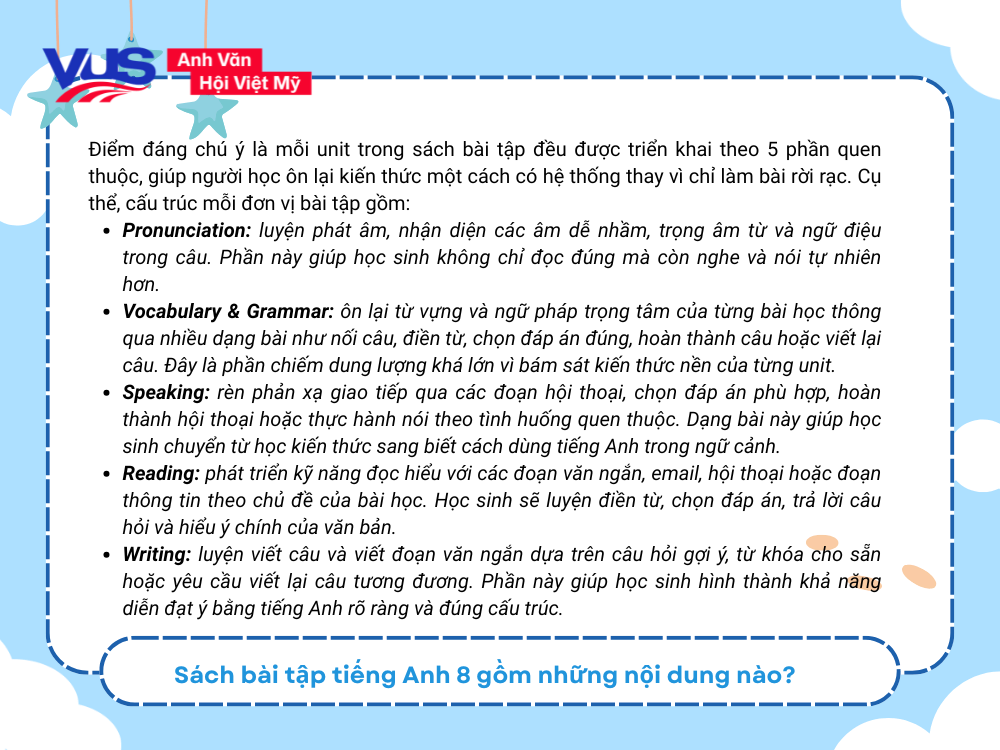
Điểm đáng chú ý là mỗi unit trong sách bài tập đều được triển khai theo 5 phần quen thuộc, giúp người học ôn lại kiến thức một cách có hệ thống thay vì chỉ làm bài rời rạc. Cụ thể, cấu trúc mỗi đơn vị bài tập gồm:
- Pronunciation: luyện phát âm, nhận diện các âm dễ nhầm, trọng âm từ và ngữ điệu trong câu. Phần này giúp học sinh không chỉ đọc đúng mà còn nghe và nói tự nhiên hơn.
- Vocabulary & Grammar: ôn lại từ vựng và ngữ pháp trọng tâm của từng bài học thông qua nhiều dạng bài như nối câu, điền từ, chọn đáp án đúng, hoàn thành câu hoặc viết lại câu. Đây là phần chiếm dung lượng khá lớn vì bám sát kiến thức nền của từng unit.
- Speaking: rèn phản xạ giao tiếp qua các đoạn hội thoại, chọn đáp án phù hợp, hoàn thành hội thoại hoặc thực hành nói theo tình huống quen thuộc. Dạng bài này giúp học sinh chuyển từ học kiến thức sang biết cách dùng tiếng Anh trong ngữ cảnh.
- Reading: phát triển kỹ năng đọc hiểu với các đoạn văn ngắn, email, hội thoại hoặc đoạn thông tin theo chủ đề của bài học. Học sinh sẽ luyện điền từ, chọn đáp án, trả lời câu hỏi và hiểu ý chính của văn bản.
- Writing: luyện viết câu và viết đoạn văn ngắn dựa trên câu hỏi gợi ý, từ khóa cho sẵn hoặc yêu cầu viết lại câu tương đương. Phần này giúp học sinh hình thành khả năng diễn đạt ý bằng tiếng Anh rõ ràng và đúng cấu trúc.
Bên cạnh đó, sách còn có các bài Test Yourself 1, 2, 3, 4. Đây là phần tự kiểm tra sau mỗi cụm bài học, giúp học sinh rà soát lại mức độ ghi nhớ kiến thức và làm quen với dạng bài đánh giá tổng hợp.
Có thể thấy sách triển khai nội dung theo đúng mạch chủ đề của chương trình. Những unit xuất hiện trong tài liệu gồm:
- Unit 1: Leisure time
- Unit 2: Life in the countryside
- Unit 3: Teenagers
- Unit 4: Ethnic groups of Viet Nam
- Unit 5: Our customs and traditions
- Unit 6: Lifestyles
- Unit 7: Environmental protection
- Unit 8: Shopping
- Unit 9: Natural disasters
- Unit 10: Communication in the future
- Unit 11: Science and technology
- Unit 12: Life on other planets
Xem thêm:
- Tổng hợp từ vựng tiếng Anh lớp 8 theo Unit
- Toàn bộ kiến thức ngữ pháp tiếng Anh lớp 8 Global Success
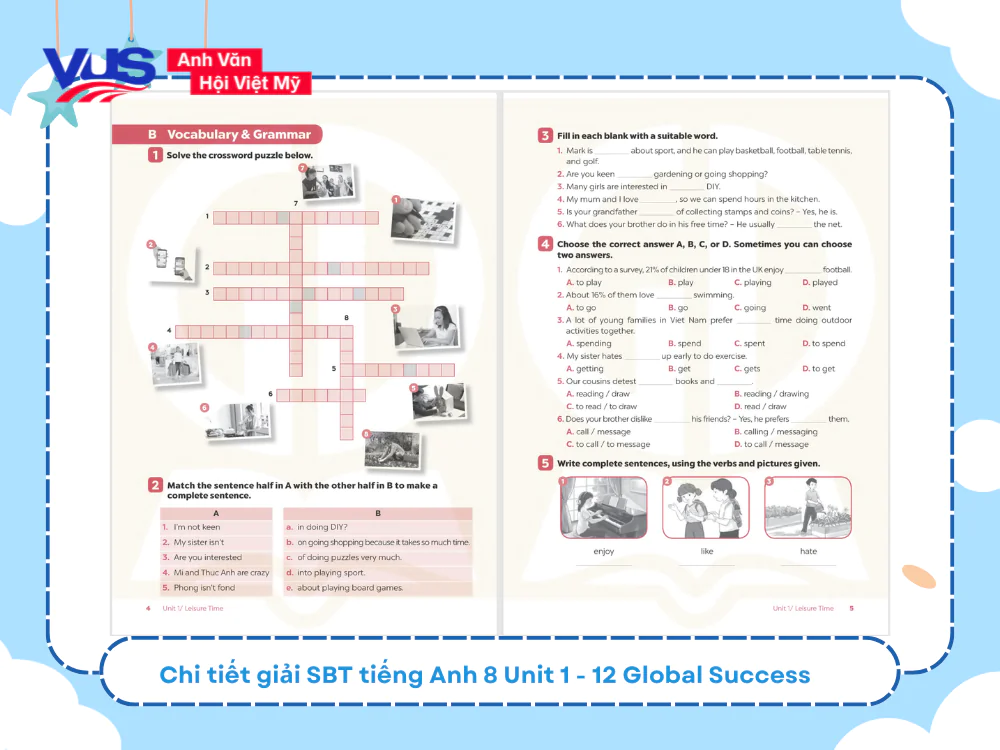
Chi tiết giải SBT tiếng Anh 8 Unit 1 - 12 Global Success
Phần dưới đây cung cấp chi tiết giải SBT tiếng Anh 8 Unit 1–12 Global Success, được trình bày theo từng bài học giúp bạn dễ dàng theo dõi và tra cứu.
Mỗi unit đều có lời giải rõ ràng, từ đó giúp bạn hiểu bản chất kiến thức và áp dụng linh hoạt khi làm bài tập cũng như trong các bài kiểm tra trên lớp.
Bạn có thể tải tại đây: SBT tiếng Anh 8 Global Success đầy đủ
Giải SBT tiếng Anh 8 Unit 1 Global Success
A. Pronunciation
1.
- book
- tofu
- soup
- wolf
- cook
- glue
- noodles
- sugar
/ʊ/: book, wolf, cook, sugar
/u:/: tofu, soup, glue, noodles
2.
- C
- B
- A
- D
- A
B. Vocabulary & Grammar
1.
- doing puzzles
- messaging friends
- surfing the net
- going shopping
- doing DIY
- cooking
- playing sport
- gardening
2.
- b
- d
- a
- e
- c
3.
- crazy
- on
- doing
- cooking
- fond
- surfs
4.
- C
- A / C
- A / D
- A / D
- B
- B
5.
- She enjoys playing the piano.
- They like talking / to talk / chatting / to chat to each other.
- He hates watering the flowers. / He hates to water the flowers.
- They love making / to make models.
- He detests cooking.
- They dislike dancing.
C. Speaking
1.
- C
- B
- A
- D
- B
2.
- B
- E
- D
- A
- C
D. Reading
1.
- tell
- best
- neighbourhood
- become
- elderly
- books
- doing
- What
2.
- A
- C
- B
- A
- C
- D
3a.
- b
- d
- a
- e
- c
3b.
- F
- T
- F
- T
- F
E. Writing
1.
- C
- A
- D
- B
- D
3. Suggested answer:
My best friend’s name is Lan. In her leisure time, she likes doing many things, but playing badminton is the activity she loves the most. She plays it almost every day with me or her sister after school. She enjoys playing badminton for these reasons. Firstly, she is an active girl, so she naturally likes sport. Secondly, badminton makes her stay fit and have fun at the same time. When she plays it, she can exercise and enjoy herself.
Giải SBT tiếng Anh 8 Unit 2 Global Success
A. Pronunciation
1.
- A
- A
- C
- D
- B
2.
- cottage
- dragon
- market
- orchard
- harvest
- carrot
/ɪ/: cottage, market, harvest
/ə/: dragon, orchard, carrot
B. Vocabulary & Grammar
1.
- C
- D
- A
- A
- B
2.
- picking
- (to) collect
- ride
- catching
- herd
3.
- B
- C
- A
- D
- D
4.
- more heavily
- harder
- more quickly
- more happily
- earlier
5.
- faster
- more carefully
- harder
- earlier
- more fluently
C. Speaking
1.
- A
- B
- A
- A
- D
2.
- D
- B
- A
- E
- C
D. Reading
1.
- B
- C
- A
- A
- C
2.
- A
- B
- C
- B
- D
3.
- F
- T
- F
- F
- T
E. Writing
1.
- His car can run faster than my car / mine (can).
- The workers in my factory work more carelessly than those in your factory / yours (do).
- The people in my town live more happily than those in her city (do).
- My mother can cook better than me / I (can).
- Living in the city is more convenient than living in the countryside (is).
3. Suggested answer:
I live in Tan Yen, a rural village in Nghe An. Its scenery is picturesque with rolling hills and vast green fields stretching as far as the eye can see. The villagers there are friendly and welcoming. They are also very honest and helpful. Most of them make their living by farming and raising livestock. Tan Yen has a traditional communal house, and here the villagers gather for festivals, celebrations, and other events. The most interesting part of Tan Yen is the Ghost Festival on 15th July (according to the lunar calendar) when villagers reunite with their relatives. The beauty of nature and the warmth of community make Tan Yen a wonderful place to live.
Giải SBT tiếng Anh 8 Unit 3 Global Success
A. Pronunciation
1.
/ʊə/: assure, usually, visual, tourism, intellectual, coward
/ɔɪ/: destroy, lifebuoy, cowboy, soil, appoint
2.
- C
- A
- B
- C
- D
B. Vocabulary & Grammar
1.
- B
- D
- B
- C
2.
- expectations
- pressure
- coaches
- bully
- concentrate
3.
- B
- C
- A
- C
- A
4.
- because
- therefore
- so
- but
- otherwise
5.
- C
- B
- C
- A
- B
C. Speaking
1.
- B
- A
- C
- A / B
- A / B
2.
- B
- A
- D
- E
- C
D. Reading
1.
- A
- D
- B
- A
- B
- C
2.
- F
- T
- T
- T
- T
- F
- T
- F
3.
- A
- A
- B
- C
- B
- D
- B
E. Writing
1.
- Teenagers should play (some) sport(s) to keep fit.
- Teens may feel stressed when their classmates do better than them at / in school.
- Some teens participate in school clubs to make new friends.
- Some teens feel pressure because they want to fit in a group.
- The main causes of teen stress include peer pressure, schoolwork pressure, and pressure from parents.
2.
- C
- B
- D
- B
- A
3. Suggested answer:
My classmate looks tired recently because she is suffering from stress. She should do several things to deal with this situation. First, she should turn off her computer and smartphone because these things cause her headaches and make her tired. Second, she should go to bed early to get enough sleep. If she lacks enough sleep, she will fall ill quickly. Third, she should talk with her friends and teachers about her problems and receive some good advice. Or at least she will feel relieved. Another thing she should do is to do more exercise to live a healthy life. Last, if a classmate annoys her, she can avoid talking to that person. She should also talk to her teachers or her parents about this annoying classmate.
TEST YOURSELF 1
1. (5 x 0.2 = 1.0 pt)
- B
- C
- D
- C
- C
2. (5 x 0.2 = 1.0 pt)
- B
- D
- D
- A
- C
3. (5 x 0.2 = 1.0 pt)
- unloading
- surrounded
- pressure
- connection
- dislike
4. (5 x 0.4 = 2.0 pts)
- C (so → but)
- C (however → otherwise)
- B (careful → carefully)
- C (to catch → catching)
- A (use → using / to use)
5. (5 x 0.2 = 1.0 pt)
- harder
- frequently
- therefore
- doing
- longer
6. (5 x 0.2 = 1.0 pt)
- A
- C
- B
- D
- B
7. (10 x 0.2 = 2.0 pts)
a.
- b
- e
- a
- d
- c
b.
6. in common
7. (better) understand
8. skills
9. confident
10. much better
8. (5 x 0.2 = 1.0 pt)
- Nam is not good at dancing; however, he is a member of the dancing club.
- Lan is fond of messaging her friends because it is more convenient than calling.
- Feeding pigs and milking cows are her daily activities.
- Today farmers in my village usually use combine harvesters to harvest their crops.
- Teenagers’ stress may come from schoolwork, family, or friends.
Giải SBT tiếng Anh 8 Unit 4 Global Success
A. Pronunciation
1.
- A
- D
- B
- C
- B
B. Vocabulary & Grammar
1.
- pagoda
- silver jewellery
- lion dance
- loom
- costume
- waterwheel
2.
- clothing
- staircase
- crops
- folk songs
- guests
- open fire
3.
- peaceful
- waterwheel
- jewellery
- loom
- handicrafts
4.
- B
- A
- D
- A
- C
5. Suggested answers:
- How many Katu people are there?
- Where do they live?
- What are the Katu like?
- What are their traditional dances?
- When do they hold the rice spirit feast?
6.
- A
- B
- D
- A
- C
C. Speaking
1.
- A
- D
- A
- B
- C
2. Suggested answers:
- In Dien Bien.
- Son La (biggest population: 482,485, making up 54.8%), Nghe An, Thanh Hoa, Lai Chau, Dien Bien, Lam Dong, and Dak Lak (with population getting smaller).
- Mainly on foot or by bicycle.
- No, they don’t. They speak different languages.
- Yes, it is. (flutes, mouth organs, bamboo harps, bronze drums, and gong).
- There are five provinces in the Central Highlands: Dak Lak, Dak Nong, Gia Lai, Kon Tum, and Lam Dong.
- The Khmer.
- Nem con / Con throwing. Minority groups in the Northern Highlands play it. (Thai, Tay, Dao, Nung…)
3. Suggested questions:
Population: What’s the population of the Thai?
Living place: Where do they mainly live?
Houses: What kind of houses do they live in?
Women costumes: What do Thai women usually wear?
Economy: What do they do for a living?
Characteristics: What are the Thai like?
Traditional culture: What are some traditional culture characteristics of the Thai?
D. Reading
1.
- B
- A
- D
- B
- C
- A
- C
- D
2.
- hard
- land
- breathing
- pollution
- air
- peaceful
3.
a.
- highland
- foot / horseback
- (any of) Tay, Nung, Dao
- plants
- food
- lover
b.
- Every Sunday. / On Sundays.
- Colourful traditional costumes.
- Yes, I / we can.
- After they finish their market activities.
E. Writing
1.
- D
- A
- C
- A
- B
2. Suggested answer:
There are about one million Hoa people in Viet Nam. They live all over the country, from the cities to the countryside. They make their living by planting wet rice, making handicrafts, and trading. The Hoa have very good cooking skills. They like fried and spicy food and healthy drinks like ginseng and daisy tea.
The Hoa’s traditional cultural activities are mainly theatrical performances, lion dances, and comedies. They perform these with flutes and stringed instruments.
Giải SBT tiếng Anh 8 Unit 5 Global Success
A. Pronunciation
1.
- D
- A
- B
- C
- B
B. Vocabulary & Grammar
1.
- an ornamental tree
- a blooming flower
- a communal house
- a bamboo pole
- bad spirits
- food offerings
- martial arts
- festival goers
2.
- A
- C
- C
- A
- C
- B
- B
- A
3.
- traditions
- practise
- custom
- traditionally
- maintain
- break
4.
- the
- Ø
- an
- Ø
- a
5.
Line 3: a → the
Line 4: a → the
Line 5: a → Ø
Line 6: ✓
Line 7: the → Ø
Line 8: ✓
Line 9: a → the
Line 10: an → a
C. Speaking
1.
- A
- B
- A
- A
- B
2.
- A
- D
- B
- E
- C
D. Reading
1.
- C
- A
- A
- B
- B
- C
- B
- A
2.
- A
- C
- B
- C
- A
3.
a.
- F
- F
- T
- T
- F
b.
- C
- B
- A
- C
- A
E. Writing
1.
- We travelled to Hue by train.
- We went to the village temple on foot.
- Ottawa is the capital of Canada.
- The Vietnamese value hard work and honesty.
- My dad doesn’t / does not drink / never drinks coffee.
3. Suggested answer:
The Boxing Day occurs on 26th December. In the UK, it is a public holiday, so people don’t have to work or study. Traditionally, on this day, all shops were closed. People shared their Christmas boxes with the poor. At present, British people maintain the tradition of giving small gifts to others on Boxing Day. They also spend the day watching sports and eating Christmas leftovers. Many shops break with tradition by opening on Boxing Day, so people may go shopping at stores.
Giải SBT tiếng Anh 8 Unit 6 Global Success
A. Pronunciation
1.
- He promised to mend the broken chair soon.
- She printed these beautiful cards with images from Brazil.
- Please do your best to prevent the children from breaking anything.
- The brakes on my bike are not working properly.
- Brian is practising the piano.
2.
- D
- A
- C
- C
- B
B. Vocabulary & Grammar
1.
- D (not a connector)
- C (not a verb)
- B (not a noun)
- A (not an adjective)
- A (not an adjective)
2.
- cultural differences
- behaviour
- practise
- healthy lifestyle
- lifestyle habits
- interactive
3.
- work / study
- greet
- in a hurry / late
- will
- unless
- throwing tomatoes
4.
- will arrive / arrives
- to reach
- will go
- will play
- rains
- will assemble
- will sit
- will get on
- will have
5. Suggested answers:
- C: He won’t go to the fancy-dress party unless his mother allows him to go.
- E: Will you take part in the race if your bike is repaired?
- A: I won’t be able to visit you tomorrow unless my sister lends me her bicycle.
- B: The project won’t be finished by next week unless we spend all evening working on it.
- D: The students won’t perform the play if they don’t like it.
6.
- B
- A
- C
- C
- A
- D
- C
- D
- D
- B
C. Speaking
1.
- A
- A
- B
- D
- C
2. Suggested answers:
- – How is life in that mountainous village?
– (It’s) very peaceful. - – Do you prefer life in a big city (to country life)?
– No. I like country life better. - – What will you do if there’s no Internet connection tomorrow?
– I’ll read books and / or play outdoors. - – What do you (often / usually) do to have a healthy lifestyle?
– I exercise, play sports, have a balanced diet, and get enough sleep.
D. Reading
1.
- B
- D
- B
- A
- C
2.
- For a year.
- No, she didn’t.
- She felt it was rude.
- His friend’s family.
- He started crying (and broke down).
3.
- for
- exercise
- eating
- take
- fresh
E. Writing
1.
- C (spending → spend)
- A (what → how)
- A (Unless → If)
- B (ensure → ensuring)
- C (in the right → on the right)
2.
- If you cook dinner, I’ll do the dishes.
- We will stay at a hotel underground if we travel to Coober Pedy, Australia.
- He won’t / can’t get a good job unless he improves his IT skills.
- If you visit our town, we will take you to a famous local restaurant.
- Unless you exercise regularly, you won’t be able to lose weight.
3. Suggested answer:
Street food has become more and more popular in cities and towns, and it has several advantages. Firstly, it is very convenient: you can find it everywhere, and you can have it anytime of the day, from early morning till late at night. Secondly, its prices are reasonable, and so most people, especially students, can afford it. Thirdly, it is usually delicious, and it easily suits everyone’s taste. In short, there are many good things about street food, so many people have it almost everyday.
TEST YOURSELF 2
1. (5 x 0.2 = 1.0 pt)
- C
- A
- B
- A
- D
2. (5 x 0.2 = 1.0 pt)
- an
- Ø
- a
- Ø
- the
3.
a. (5 x 0.2 = 1.0 pt)
- d
- b
- a
- e
- c
b. (5 x 0.2 = 1.0 pt)
- ceremony
- costume
- speciality
- custom
- folk dance
4. (5 x 0.2 = 1.0 pt)
- will you buy
- collapses
- won’t miss
- rains
- Will you go
5. (5 x 0.2 = 1.0 pt)
- B
- A
- D
- C
- E
6. (5 x 0.2 = 1.0 pt)
- B
- C
- D
- A
- C
7. (5 x 0.2 = 1.0 pt)
- A
- C
- D
- B
- B
8. (5 x 0.4 = 2.0 pts)
- Doctors warn them to adopt a healthier lifestyle as they are overweight.
- I think there are some similarities between a custom and a tradition.
- Why do people in the Central Highlands organise the Elephant Racing Festival?
- Americans decorate their homes to make them look scary at Halloween.
- My family has a custom of cooking sticky rice on the first day of each lunar month.
Giải SBT tiếng Anh 8 Unit 7 Global Success
A. Pronunciation
1.
- The clock on the wall is blue.
- He climbed the tree and got a lot of blackberries.
- Don’t blame me for your broken ankle.
- He posts messages, photos, and video clips on his blog.
- The blonde girl went to buy pickles.
2.
- C
- D
- A
- B
- C
B. Vocabulary & Grammar
1.
- acid rain
- domestic waste
- greenhouse effect
- loud noise
- global warming
- forest fire
2.
- harmful
- organisation
- environmentally
- importance
- destruction
- unbelievable
3.
- national
- light
- planting
- control
- released
- technological
4.
- We were planting trees while our friends were collecting rubbish.
(Our friends were collecting rubbish while we were planting trees.) - The choir practised for half an hour before they went on stage / before going on stage.
(Before they went on stage / Before going on stage, the choir practised for half an hour.) - After I read my favourite book / After reading my favourite book, I went to bed.
(I went to bed after I read my favourite book / after reading my favourite book.) - When the bell rang, everyone raced out of the classroom.
(Everyone raced out of the classroom when the bell rang.) - Don’t go away until you finish / have finished cleaning up the place.
- Whenever my sister makes a mess, my mum makes her weed the garden.
(My mum makes my sister weed the garden whenever she makes a mess.)
5. Suggested answers:
- After I finish putting these things away, I’ll give you a hand.
- Wherever you go, you can always find good people.
- While I was watering the flowers, my sister was cooking dinner.
- We had a hard time finding the way to our hotel when we were in Bangkok.
- Before you leave your room, you should turn off the light(s).
- We were impressed by the beautiful buildings when we visited Saint Petersburg.
6.
- B
- B
- C
- A
- C
- D
- A
- A
- D
- B
C. Speaking
1. Suggested answer:
A: What does ‘soil pollution’ mean? / What do you mean by ‘soil pollution’?
B: ‘Soil pollution’ is the presence of toxic chemicals in soil.
A: And what does ‘climate change’ mean? / what do you mean by ‘climate change’?
B: It is long-term changes in temperatures and weather patterns.
A: Oh, thank you.
D. Reading
1.
- C
- B
- A
- C
- D
2.
- B
- C
- A
- A
- D
3.
- into
- extinct
- environment
- trees
- destroying
E. Writing
1.
- … before mum gets home.
- … while he is driving.
- … we saved a lot of power.
- … as soon as the boys left the campsite.
- … until they install a new generator.
- …, follow the three R's to conserve natural resources.
2.
- A
- B
- D
- D
- C
3. Suggested answer:
Cuc Phuong National Park is located in Nho Quan District, Ninh Binh Province. It became a national park in 1962. Its area is about 222 sq. km. It was Viet Nam’s first national park and it is now still the largest. This park has a rich diversity of plants and animals. Many species in the Viet Nam Red Book of Endangered Species are found here. The park has the Endangered Primate Rescue Centre and Turtle Conservation Centre, which help to save a lot of species from extinction.
Giải SBT tiếng Anh 8 Unit 8 Global Success
A. Pronunciation
1.
/sp/
display
special
sport
speaker
crisp
/st/
assistant
system
cost
customer
honest
B. Vocabulary & Grammar
1.
- B
- C
- A
- D
- B
2.
- Internet access
- bargain
- browse
- complaint
- customer
- shopaholic
3.
- B
- D
- C
- A
- C
4.
- seller
- shipping
- attraction
- decorations
- products
5.
- never
- always
- rarely
- sometimes
- often
6.
- A
- D
- C
- B
- A
C. Speaking
1.
- B
- D
- A
- B
- C
2.
- D
- C
- A
- E
- B
D. Reading
1.
- A
- C
- B
- D
- A
- C
2.
- T
- F
- T
- T
- T
3.
- Throughout cities in many countries.
- From the public.
- No, it isn’t.
- To raise money for charities.
- Homeless people, people with disabilities, and the disadvantaged.
E. Writing
1.
- C
- B
- A
- D
- A
2. Suggested answer:
Co-op Food is a food retailer chain. It was founded in 1844. Its original purposes were to treat the local people with respect and to provide affordable food for everybody. Nowadays, Co-op Food has about 4,500 stores all over the country. They provide a wide range of food, from fresh or frozen to dried and canned food. Co-op Food is well-known as the oldest and most trusted retailer in the UK.
Giải SBT tiếng Anh 8 Unit 9 Global Success
A. Pronunciation
1.
- C
- D
- A
- B
- C
B. Vocabulary & Grammar
1.
- TORNADO
- NATURAL DISASTER
- EARTHQUAKE
- FLOOD
- VOLCANIC ERUPTION
- LANDSLIDE
- STORM
2.
- D
- B
- C
- D
- A
3.
- emergency kit
- property
- victims
- warning
- erupted
4.
- were having
- Were … talking
- was watering
- wasn’t doing; was playing
- were watching
5.
- happened; were doing
- Were … talking
- was cooking; came
- gathered; broke
- were … doing; arrived
6.
- C (was seeing → saw)
- A (wasn’t → didn’t)
- A (While → When)
- A (listened → was listening)
- B (was → were)
C. Speaking
1.
- C
- B
- A
- D
- B
2.
- B
- E
- D
- A
- C
D. Reading
1.
- control
- causes
- loss
- answer
- difficult
- before
- earthquakes
- happen
2.
- A
- C
- B
- A
- A
- D
- B
- D
3.
a.
- b
- d
- a
- c
b
Ann: 4, 5; Nick: 2, 3; Hung: 1, 6
E. Writing
1.
- C
- A
- D
- B
- D
2.
- Mark was doing a crossword puzzle.
- Mai and Lan were singing a pop song.
- Phong was cleaning the board.
- Nick and Nam were reading a comic book together.
- Mi was drawing something in her notebook.
3. Suggested answer:
A storm is a natural disaster that often happens in Viet Nam. It happens every year, and the storm season lasts from June to November. Before a storm, people usually strengthen their homes and bring in outdoor things like flowerpots or rubbish bins. They also prepare some food and drinks in case they cannot go out. After the storm, people usually do not leave their homes right away. They listen to important instructions from local authorities to know which parts of their area are dangerous and should be avoided. They also stay away from broken power lines.
TEST YOURSELF 3
1. (5 x 0.2 = 1.0 pt)
- D
- A
- C
- C
- B
2. (5 x 0.2 = 1.0 pt)
- A
- C
- D
- B
- B
3. (5 x 0.4 = 2.0 pts)
- important
- products
- disasters
- traditional
- awareness
4. (5 x 0.2 = 1.0 pt)
- d
- c
- a
- b
- e
5. (5 x 0.2 = 1.0 pt)
- C
- A
- B
- B
- D
6. (5 x 0.2 = 1.0 pt)
- were doing
- continued
- will start
- is
- decide
7.
a. (5 x 0.2 = 1.0 pt)
- F
- T
- T
- T
- T
b. (4 x 0.25 = 1.0 pt)
- lungs
- carbon dioxide
- habitats
- planting
8. (5 x 0.2 = 1.0 pt)
- As soon as they heard the cracking sound, they ran out of the house.
(They ran out of the house as soon as they heard the cracking sound.) - We stayed in the shelter till the storm ended.
- You should make a shopping list before you go shopping / before going shopping.
(Before you go shopping / Before going shopping, you should make a shopping list.) - After the flood waters drained, we returned home.
(We returned home after the flood waters drained.) - While we were surfing / While surfing the Internet, we saw calls for joining programmes to save endangered species.
(We saw calls for joining programmes to save endangered species while we were surfing / while surfing the Internet.)
Giải SBT tiếng Anh 8 Unit 10 Global Success
A. Pronunciation
1.
- D
- B
- D
- C
- A
B. Vocabulary & Grammar
1.
- A
- B
- A
- A
- D
- C
- B
- C
2.
- D
- A
- B
- A
- D
3.
- person
- social networking sites
- hours
- face to face
- convenient
- instant messages
4.
- in
- on
- at
- for
- By
- next to
- in
- opposite
5.
- B
- C
- B
- A
- A
- C
- B
- B
C. Speaking
1.
- B
- B
- A
- B
- A
2.
- D
- C
- E
- A
- B
D. Reading
1.
- B
- A
- B
- C
- B
- A
- A
- C
2.
- A video conference
- A video conference
- A translation machine
- A video conference
- both
- A translation machine
3.
a.
- B
- A
- C
- A
- C
b.
- change their shapes
- holographic
- read
- mood
- human friends
E. Writing
1.
- We talked on the phone for more than an hour yesterday.
- In the near future, mobile phones will run on solar energy.
- Telepathy devices will become popular in 30 years.
- If we use our phones too much, we will become dependent on them.
- Many teenagers prefer chatting on the Internet to meeting their friends in person.
3. Suggested answer:
A lot of people communicate by emails these days. An email is a letter that people send to each other via the Internet. There are many advantages of using an email. First, it is time-saving. An email can reach the recipients within seconds, so people can exchange information very quickly. In addition, it is efficient. An email can carry a lot of information because the sender can attach pictures, sounds, and videos to it. However, email users sometimes feel irritated when they receive spam and emails that carry viruses. Anyway, sending emails is very convenient, so it will continue being a popular way of communication in the future.
Giải SBT tiếng Anh 8 Unit 11 Global Success
A. Pronunciation
2.
- 3
- 5
- 4
- 3
- 5
- Who discovered America?
- Robot ASIMO won’t work anymore.
- Scientists will never stop researching.
- Can you talk about recent inventions?
- Are you developing a new robot? – Yes, we are.
B. Vocabulary & Grammar
1.
- B
- A
- A
- B
2.
- experiments
- platform
- face recognition
- attendance
- Video conferencing
3.
- A
- B
- C
- D
- A
4.
- C
- A
- C
- A
- B
5.
- C
- B
- D
- C
- A
C. Speaking
1.
- B
- A
- C
- D
- A
2.
- E
- D
- A
- B
- C
D. Reading
1.
- science
- role
- children / they
- give
- skills
- future
- in
2.
- F
- T
- F
- F
- T
- T
- F
3.
- B
- C
- A
- C
- D
- A
- B
E. Writing
1.
- Charles Babbage, an English polymath, designed three computers.
- He never constructed a computer because he did not have enough money.
- In 1822, Babbage started working on the first computer and it was called the Difference Engine.
- From 1847 to 1849, Babbage created the second computer.
- In 1991, the British Science Museum constructed the computer from Babbage’s plans.
- It took 6 years to build this new computer, and it worked.
2.
- C
- B
- D
- C
- B
3. Suggested answer:
People can face some problems if they own a home robot. First, robots are expensive, so not every family can afford to have one. Second, people can become lazy because the robot does things for them. In addition, robots can’t do all things as well as humans can do. For example, robots can do the cooking but they cannot taste a dish to check if it is good enough. Furthermore, robots cannot do everything. They can only do things that they are programmed. So you should think carefully before buying a robot.
Giải SBT tiếng Anh 8 Unit 12 Global Success
A. Pronunciation
1.
- I enjoy boxing, swimming, hiking, and cycling.
- We’ve got apples, pears, bananas, and oranges.
- The sweater comes in blue, white, pink, and black.
- I like football, tennis, basketball, and volleyball.
- I bought a T-shirt, a skirt, and a handbag.
2.
- A: On what day do you have English lessons?
B: We have English lessons on Mondays, Wednesdays, Thursdays, and Fridays. - A: What can I get you, sir?
B: We’d like some beef, some potatoes, some spaghetti, and an omelette. - A: What did you buy at the corner shop yesterday?
B: I bought a T-shirt, a jumper, a dress, and a hat. - A: What sports do you like?
B: I like football, tennis, fishing, and jogging. - A: What fruits do you have today?
B: We’ve got apples, pears, bananas, and oranges.
B. Vocabulary & Grammar
1.
- crater
- galaxy
- telescope
- rocket
- liquid
- aliens
2.
- aliens
- galaxy
- crater
- telescope
- rocket
- Liquid
3.
- A
- C
- A
- D
- B
4.
- there were
- I was
- were exploring
- that day
- would
5.
- Hai asked Hoa how often she visited her grandparents.
- She asked me what a UFO looked like.
- The student asked his teacher why the climate on Mars was unsuitable for human life.
- I wondered which was longer, a day on Venus or a day on Earth.
- My son asked me why people called Mars the Red Planet.
6.
- Which hotel are you staying at now?
- What is in your suitcase?
- Whose car is that / this?
- Who are you going to meet tonight?
- When are you going to leave for Paris?
C. Speaking
1.
- A
- B
- B
- D
- B
2.
- C
- D
- E
- B
- A
D. Reading
1.
- B
- C
- A
- A
- C
- B
- A
- C
- B
- A
2.
- A
- A
- D
- B
- D
3.
- F
- T
- F
- T
- T
E. Writing
1.
- The professor asked his students what the essential conditions for human life were.
- Tom asked the scientist what they used to catch signals from aliens.
- I asked the teacher why people / we couldn’t move to Mars immediately.
- The headmaster wanted to know who was on duty that day.
- Mary asked me what the word UFO stood for.
3. Suggested answer:
Saturn is named after the Roman god of agriculture and wealth, and its name means “the watcher.” Saturn is the second largest planet in our solar system, about 116,460 km in diameter. It has a very thin atmosphere composed mainly of hydrogen and helium. The average temperature on Saturn is -139°C, and temperatures can drop to as low as -220°C. The most outstanding feature of the planet is its beautiful rings. They are made up of billions of particles of ice and rock. Saturn also has 83 moons, including Titan, the second largest moon in our solar system.
TEST YOURSELF 4
1. (5 x 0.2 = 1.0 pt)
- D
- C
- D
- B
- C
2. (8 x 0.125 = 1.0 pt)
- A
- A
- C
- B
- D
- C
- B
- A
3. (5 x 0.2 = 1.0 pt)
- holography
- galaxies
- video conference
- eye-tracking
- habitable
4. (5 x 0.2 = 1.0 pt)
- D (on → in)
- A (said → said to / told)
- B (what → why)
- B (us → ours)
- D (tomorrow → the next day / the following day)
5. (5 x 0.2 = 1.0 pt)
- B
- C
- A
- B
- A
6. (8 x 0.125 = 1.0 pt)
- A
- D
- B
- C
- B
- A
- D
- A
7. (5 x 0.4 = 2.0 pts)
- T
- F
- F
- T
- T
8. (5 x 0.4 = 2.0 pts)
- Jack is video conferencing / having a video conference with his colleagues in Asia at the moment.
- He said that he was doing well in science at school then.
- Nick asked the professor why humans couldn’t live on Mars.
- Robots will replace humans in 30 years’ time.
- Many students asked me what the differences between Mars and Earth were.
Sau khi nắm chắc kiến thức trong sách và luyện bài tập theo từng unit, nhiều học sinh vẫn cần một lộ trình học bài bản hơn để củng cố nền tảng, sửa lỗi đúng chỗ và tiến bộ đều ở cả 4 kỹ năng. Đây cũng là lúc một chương trình học phù hợp có thể tạo khác biệt rõ rệt.
Tại VUS, các khóa học được thiết kế theo từng độ tuổi và mục tiêu học tập cụ thể, từ chương trình tiếng Anh cho trẻ mầm non, khóa học tiếng Anh tiểu học, chương trình tiếng Anh THCS, đến các lộ trình tiếng Anh giao tiếp, luyện thi IELTS và tiếng Anh cho người mất gốc.
Nhờ định hướng rõ đầu ra, phương pháp học phù hợp từng giai đoạn và hệ thống theo dõi tiến độ sát sao, VUS giúp người học không chỉ làm tốt bài tập trên lớp mà còn từng bước phát triển khả năng sử dụng tiếng Anh tự tin, thực tế và bền vững hơn.
Điền form tư vấn ngay để VUS giúp bạn chọn đúng khóa học phù hợp với trình độ và mục tiêu hiện tại.

Cách học với phần giải SBT tiếng Anh 8 để đạt hiệu quả tốt hơn
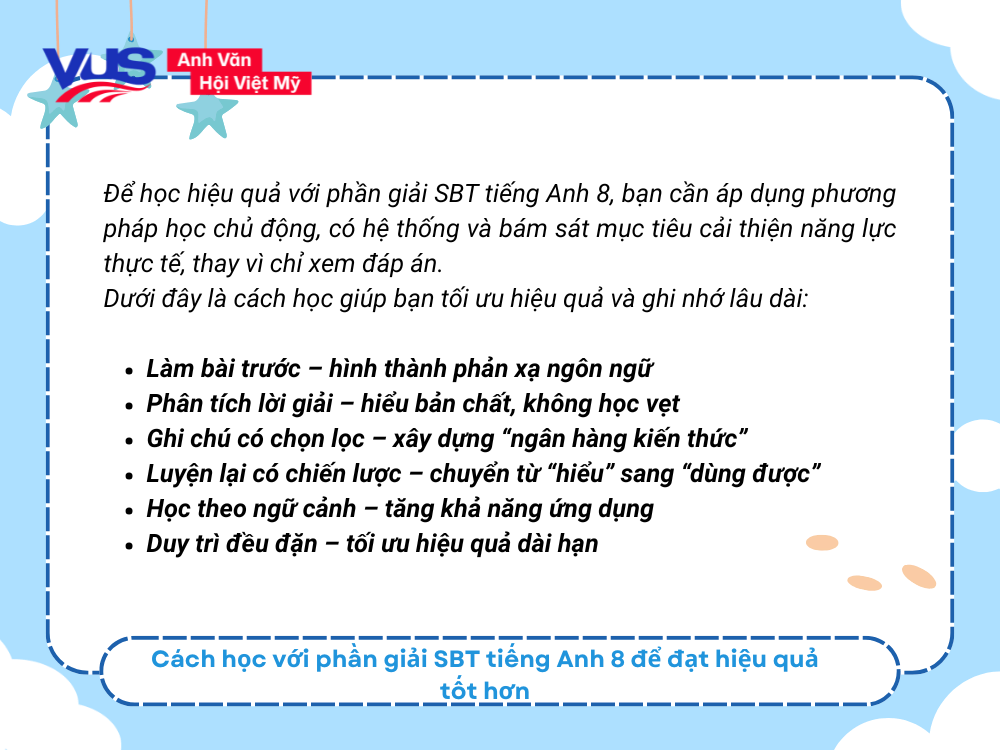
Để học hiệu quả với phần giải SBT tiếng Anh 8, bạn cần áp dụng phương pháp học chủ động, có hệ thống và bám sát mục tiêu cải thiện năng lực thực tế, thay vì chỉ xem đáp án. Dưới đây là cách học giúp bạn tối ưu hiệu quả và ghi nhớ lâu dài:
- Làm bài trước – hình thành phản xạ ngôn ngữ: Trước khi xem lời giải, hãy tự làm toàn bộ bài tập trong SBT như một bài kiểm tra thật. Điều này giúp bạn rèn luyện tư duy, phản xạ tiếng Anh và xác định chính xác phần kiến thức còn yếu như từ vựng, thì động từ hay cấu trúc câu.
- Phân tích lời giải – hiểu bản chất, không học vẹt: Khi đối chiếu với phần giải, đừng chỉ quan tâm đúng – sai. Hãy phân tích kỹ từng đáp án: vì sao đúng, sai ở đâu, sai do ngữ pháp, từ loại hay ngữ cảnh. Đây là bước quan trọng giúp bạn hiểu sâu và tránh lặp lại lỗi tương tự.
- Ghi chú có chọn lọc – xây dựng “ngân hàng kiến thức”: Hãy tạo một cuốn sổ tay và ghi lại những nội dung quan trọng như: cấu trúc ngữ pháp, từ vựng theo chủ đề, collocations và lỗi sai điển hình. Việc ghi chép có hệ thống sẽ giúp bạn dễ dàng ôn tập và củng cố kiến thức trước mỗi kỳ kiểm tra.
- Luyện lại có chiến lược – chuyển từ “hiểu” sang “dùng được”: Sau 1–2 ngày, hãy làm lại các bài đã sai mà không nhìn lời giải. Điều này giúp bạn kiểm tra mức độ ghi nhớ và biến kiến thức thành kỹ năng sử dụng thực tế, đặc biệt hiệu quả với các dạng bài ngữ pháp và viết lại câu.
- Học theo ngữ cảnh – tăng khả năng ứng dụng: Đừng học rời rạc từng câu. Hãy đặt câu, viết lại hoặc paraphrase dựa trên cấu trúc đã học, ưu tiên các chủ đề quen thuộc như trường học, bạn bè, sở thích. Cách học này giúp bạn sử dụng tiếng Anh linh hoạt hơn trong giao tiếp và bài thi.
- Duy trì đều đặn – tối ưu hiệu quả dài hạn: Thay vì học dồn, hãy chia nhỏ nội dung theo từng Unit và học mỗi ngày. Học ít nhưng chắc, kết hợp giữa làm bài – phân tích – ghi chú – luyện lại sẽ giúp bạn tiến bộ rõ rệt.
Tóm lại, giải SBT tiếng Anh 8 không chỉ là tài liệu hỗ trợ kiểm tra đáp án mà còn là công cụ giúp bạn hiểu sâu kiến thức và nâng cao kỹ năng một cách bền vững. Khi biết cách khai thác hiệu quả từng lời giải, bạn sẽ dần hình thành tư duy ngôn ngữ, hạn chế lỗi sai và tự tin hơn trong học tập.
Hãy học một cách chủ động, kiên trì theo từng Unit và luôn kết hợp giữa làm bài – phân tích – luyện lại. Đây chính là chìa khóa giúp bạn chinh phục chương trình tiếng Anh 8 và đạt kết quả cao trong các bài kiểm tra cũng như kỳ thi quan trọng.
Câu hỏi thường gặp về giải SBT tiếng Anh 8
-
Giải SBT tiếng Anh 8 có bám sát chương trình trên lớp không?
 Phần giải SBT tiếng Anh 8 được biên soạn bám sát chương trình Global Success và nội dung giảng dạy trên lớp, bao gồm đầy đủ từ vựng, ngữ pháp và kỹ năng theo từng Unit. Lời giải thường dựa trên chuẩn SGV nên đảm bảo tính chính xác, giúp học sinh ôn tập đúng trọng tâm và không bị lệch kiến thức khi tự học tại nhà.
 -
Nên xem giải trước hay làm bài trước?
Để đạt hiệu quả cao, bạn nên làm bài trước rồi mới xem giải. Cách này giúp rèn luyện tư duy, phản xạ và khả năng ghi nhớ. Phần giải SBT tiếng Anh 8 chỉ nên dùng để kiểm tra và phân tích lỗi sai, từ đó hiểu sâu kiến thức thay vì phụ thuộc vào đáp án, tránh học thụ động và kém hiệu quả. -
Làm sao để tra cứu giải SBT tiếng Anh 8 nhanh hơn?
Để tra cứu giải SBT tiếng Anh 8 nhanh, bạn nên tìm theo Unit, dạng bài hoặc từ khóa cụ thể như “Unit 5 grammar” hoặc “reading Unit 8”. Ngoài ra, việc lưu lại nguồn uy tín và đánh dấu (bookmark) các trang thường dùng sẽ giúp bạn tiết kiệm thời gian, dễ dàng ôn tập và tra cứu khi cần thiết.


100% giáo viên tại VUS sở hữu chứng chỉ giảng dạy tiếng Anh Quốc tế (TESOL, CELTA,…). VUS tiên phong phát triển phương pháp giảng dạy Discovery Learning (Học Thông Qua Khám Phá) được phát triển dựa trên triết lý giáo dục Constructivism (Kiến tạo) – nơi học viên không chỉ học một ngôn ngữ, mà còn học cách tư duy, phản biện và làm chủ tri thức.














![[ĐẦY ĐỦ] Giải tiếng Anh lớp 4 Global Success A-Z (SGK + SBT)](https://cdn.jsdelivr.net/gh/vusanhvanhoivietmy/cdn@v1.1.366/webroot/upload/202509/9ab19f806e4fbb2db6c37168ca746587.webp "[ĐẦY ĐỦ] Giải tiếng Anh lớp 4 Global Success A-Z (SGK + SBT)")

Vui lòng để lại thông tin phía dưới để được tư vấn miễn phí


Phạm Việt Thục Đoan
IELTS
8.5

Doãn Bá Khánh Nguyên
IELTS
8.5

Nguyễn Lê Huy
IELTS
8.0
Võ Ngọc Bảo Trân
IELTS
8.0

Nguyễn Đăng Minh Hiển
144
KET

Ngô Nguyễn Bảo Nghi
143
KET

Đỗ Huỳnh Gia Hân
Starters
15
Khiên

Võ Nguyễn Bảo Ngọc
Starters
15
Khiên

Nguyễn Võ Minh Khôi
Movers
15
Khiên

Nguyễn Đặng Nhã Trúc
Starters
15
Khiên
Môi trường học tập
chuẩn Quốc tế
Cơ sở vật chất, giáo viên và chứng nhận từ đối tác quốc tế mang đến môi trường giáo dục tiếng Anh hàng đầu với trải nghiệm học tập tốt nhất cho học viên.

Vui lòng để lại thông tin phía dưới để được tư vấn miễn phí



 Chat messenger
 Chat Zalo OA VUS


