


Soạn Tiếng Anh 12 Unit 10 Lifelong learning có đáp án A-Z

Để hiểu bài nhanh và làm bài chính xác, việc nắm rõ nội dung là điều rất quan trọng. Trong Tiếng Anh 12 Unit 10 Lifelong Learning, bạn sẽ khám phá chủ đề học tập suốt đời cùng hệ thống từ vựng và cấu trúc ngữ pháp quan trọng thường xuất hiện trong bài kiểm tra.
Bài viết dưới đây:
- Tổng hợp đầy đủ nội dung trọng tâm của Tiếng Anh 12 Unit 10 Lifelong Learning gồm từ vựng, ngữ pháp xoay quanh chủ điểm học tập suốt đời.
- Hệ thống kiến thức được trình bày theo từng kỹ năng như Reading, Speaking, Listening, Writing,... giúp bạn nắm rõ cấu trúc bài học.
- Bổ sung bài tập ôn luyện và câu hỏi thường gặp để củng cố kiến thức và hiểu sâu nội dung Unit 10.
Table of Contents
Tổng hợp từ vựng tiếng Anh 12 Unit 10
Phần từ vựng Tiếng Anh 12 Unit 10 tập trung vào chủ đề học tập suốt đời với nhiều từ và cụm từ quan trọng thường xuất hiện trong bài học. Nắm vững các từ vựng này sẽ giúp bạn hiểu nội dung nhanh hơn và làm tốt các bài Reading, Listening cũng như Writing.
|
STT |
Từ tiếng Anh |
Từ loại |
Nghĩa tiếng Việt |
Ví dụ |
|
1 |
summary |
n |
bản tóm tắt |
Please write a short summary of the article about lifelong learning. |
|
2 |
boost |
v |
thúc đẩy, tăng cường |
Online courses can boost your confidence and skills. |
|
3 |
brush up |
phr.v |
ôn lại, trau dồi lại |
I need to brush up on my English before the interview. |
|
4 |
press |
v |
nhấn (nút) |
Press this button to start the online lesson. |
|
5 |
trouble |
n |
rắc rối, khó khăn |
Many school-leavers have trouble choosing a suitable course. |
|
6 |
maintain |
v |
duy trì |
Lifelong learning helps you maintain your professional skills. |
|
7 |
inform |
v |
thông báo, cung cấp thông tin |
The website will inform learners about new programmes. |
|
8 |
report |
n/v |
báo cáo; báo cáo lại |
Students must report their learning progress every month. |
|
9 |
physical |
adj |
(thuộc) thể chất |
Doing physical activities helps you stay healthy while studying. |
|
10 |
midnight |
n |
nửa đêm |
I finished the online assignment before midnight. |
|
11 |
martial art |
n |
võ thuật |
He learns a martial art to keep fit and reduce stress. |
|
12 |
journal |
n |
nhật ký tạp chí |
Keep a learning journal to track what you’ve learned. |
|
13 |
take up |
phr.v |
bắt đầu (một sở thích/hoạt động) |
She decided to take up coding through an online course. |
|
14 |
keep fit |
phr |
giữ dáng/giữ sức khoẻ |
You can study better if you keep fit and sleep well. |
|
15 |
instructor |
n |
giảng viên, người hướng dẫn |
The instructor gave useful feedback on our presentations. |
|
16 |
interrupt |
v |
làm gián đoạn, ngắt lời |
Please don’t interrupt when someone is sharing an idea. |
|
17 |
register |
v |
đăng ký |
You can register for the course on the institution’s website. |
|
18 |
manage |
v |
quản lý, sắp xếp |
Working students need to manage their time carefully. |
|
19 |
up-to-date |
adj |
cập nhật, mới nhất |
The course materials are always up-to-date. |
|
20 |
lifelong |
adj |
suốt đời |
Lifelong learning helps you adapt to changes in life and work. |
|
21 |
face-to-face |
adj/adv |
trực tiếp (không qua mạng) |
Some learners prefer face-to-face classes for speaking practice. |
|
22 |
signature |
n |
chữ ký |
Don’t forget your signature on the registration form. |
|
23 |
enroll |
v |
ghi danh, nhập học |
Many school-leavers enroll in vocational programmes. |
|
24 |
distance |
n |
khoảng cách; (học) từ xa |
Distance learning is convenient for busy adults. |
|
25 |
journey |
n |
hành trình |
Learning is a long journey, not a short race. |
|
26 |
well-rounded |
adj |
toàn diện |
Lifelong learning helps you become more well-rounded. |
|
27 |
vocational |
adj |
(thuộc) dạy nghề |
Vocational training prepares learners for real jobs. |
|
28 |
school-leaver |
n |
học sinh vừa rời ghế nhà trường |
A school-leaver may need guidance to choose the right path. |
|
29 |
wonder |
v |
tự hỏi |
I wonder which course will suit my career goals. |
|
30 |
graduation |
n |
lễ/việc tốt nghiệp |
After graduation, he took a short course to improve his skills. |
|
31 |
process |
n |
quá trình |
Learning is a process that requires time and effort. |
|
32 |
attitude |
n |
thái độ |
A positive attitude makes self-study more effective. |
|
33 |
relevant |
adj |
liên quan, phù hợp |
Choose courses that are relevant to your future job. |
|
34 |
adapt |
v |
thích nghi |
Lifelong learners can adapt to new technology quickly. |
|
35 |
employment |
n |
việc làm, sự tuyển dụng |
Vocational education can improve employment opportunities. |
|
36 |
widen |
v |
mở rộng |
Reading more can widen your knowledge and vocabulary. |
|
37 |
motivated |
adj |
có động lực |
He stays motivated by setting small weekly goals. |
|
38 |
hardship |
n |
khó khăn, gian khổ |
Some learners overcome hardship to continue studying. |
|
39 |
imprison |
v |
bỏ tù, giam giữ |
The story shows how education can change someone after being imprisoned. |
|
40 |
poem |
n |
bài thơ |
She wrote a poem about her learning journey. |
|
41 |
effort |
n |
nỗ lực |
Improving speaking skills takes time and effort. |
|
42 |
improve |
v |
cải thiện |
Daily practice can improve your pronunciation. |
|
43 |
self-study |
n |
tự học |
Self-study is useful when you can’t attend classes regularly. |
|
44 |
complex |
adj |
phức tạp |
Some topics look complex, but they become easier with practice. |
|
45 |
solve |
v |
giải quyết |
Group discussions help students solve problems together. |
|
46 |
pursuit |
n |
sự theo đuổi |
Learning should be a lifelong pursuit, not a one-time goal. |
|
47 |
determination |
n |
sự quyết tâm |
With determination, you can finish any course you start. |
|
48 |
acquire |
v |
tiếp thu, đạt được |
Learners acquire new skills through practice and feedback. |
|
49 |
obstacle |
n |
trở ngại |
Lack of time is a common obstacle for adult learners. |
|
50 |
professional |
adj |
chuyên nghiệp; thuộc nghề nghiệp |
A professional certificate can support your career. |
|
51 |
satisfied |
adj |
hài lòng |
She felt satisfied after completing the online programme. |
|
52 |
carry on |
phr.v |
tiếp tục |
Even when it’s hard, try to carry on learning every day. |
|
53 |
broaden |
v |
mở rộng |
Reading widely can broaden your horizons. |
|
54 |
horizon |
n |
chân trời; tầm nhìn |
Learning a new language can open new horizons. |
|
55 |
negative |
adj |
tiêu cực |
Don’t be negative when you make mistakes in learning. |
|
56 |
retire |
v |
nghỉ hưu |
Some people start learning a new skill after they retire. |
|
57 |
active |
adj |
năng động; tích cực |
Keep active in class by asking questions and sharing ideas. |
|
58 |
symptom |
n |
triệu chứng |
Stress is a common symptom when deadlines are too close. |
|
59 |
delay |
v/n |
trì hoãn; sự trì hoãn |
Don’t delay your study plan if you want real progress. |
|
60 |
Psychology |
n |
tâm lý học |
Psychology helps us understand how people learn effectively. |
|
61 |
Molecular |
adj |
(thuộc) phân tử |
She is taking a Molecular Biology course at university. |
|
62 |
earn |
v |
kiếm được; đạt được |
You can earn a certificate after completing the course. |
|
63 |
career |
n |
sự nghiệp |
Lifelong learning supports your career development. |
|
64 |
useful |
adj |
hữu ích |
The instructor gave useful tips for self-study. |
|
65 |
engage in |
phr.v |
tham gia vào |
Students should engage in group work to practise communication. |
|
66 |
institution |
n |
cơ sở/đơn vị (giáo dục) |
This institution offers both online and face-to-face classes. |
Ngữ pháp cốt lõi trong tiếng Anh 12 Unit 10
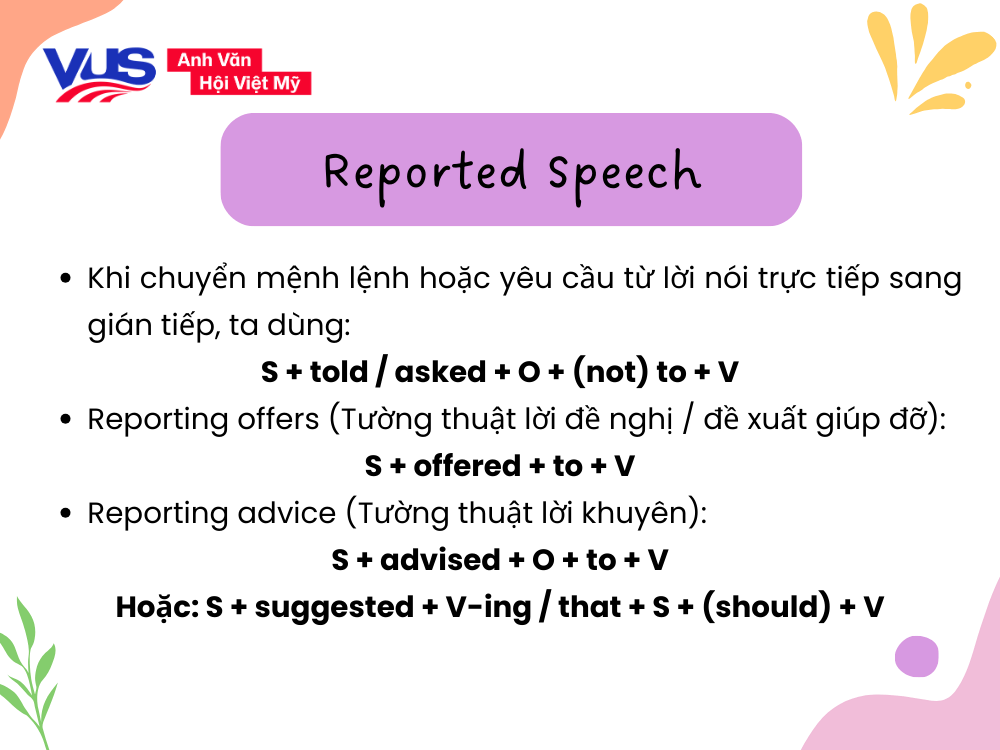
Trong Tiếng Anh 12 Unit 10 – Lifelong Learning, ngữ pháp trọng tâm không chỉ dừng lại ở câu gián tiếp cơ bản, mà tập trung vào Reported Speech dùng để tường thuật mệnh lệnh, yêu cầu, đề nghị và lời khuyên.
1. Reported speech: Reporting orders & requests (Tường thuật mệnh lệnh và yêu cầu)
Khi chuyển mệnh lệnh hoặc yêu cầu từ lời nói trực tiếp sang gián tiếp, ta dùng:
S + told / asked + O + (not) to + V
- told → dùng cho mệnh lệnh
- asked → dùng cho yêu cầu lịch sự
Ví dụ:
- Direct: “Finish the course before graduation.”
→ The instructor told us to finish the course before graduation. - Direct: “Please don’t delay your registration.”
→ She asked me not to delay my registration.
Lưu ý: Không dùng “said to” trong cấu trúc này.
2. Reported speech: Reporting offers (Tường thuật lời đề nghị / đề xuất giúp đỡ)
Công thức:
S + offered + to + V
Dạng này thường xuất hiện khi nói về hỗ trợ học tập hoặc định hướng nghề nghiệp.
Ví dụ:
Direct: “I’ll help you improve your presentation skills.”
→ He offered to help me improve my presentation skills.
Cấu trúc này giúp bài viết học thuật trở nên trang trọng và chính xác hơn.
3. Reported speech: Reporting advice (Tường thuật lời khuyên)
Trong Unit 10, lời khuyên thường xoay quanh việc học tập suốt đời, lựa chọn nghề nghiệp hoặc phát triển kỹ năng.
Công thức:
S + advised + O + to + V
Hoặc:
S + suggested + V-ing / that + S + (should) + V
Ví dụ:
- Direct: “You should take up a vocational course.”
→ She advised me to take up a vocational course. - Direct: “You should widen your knowledge.”
→ He suggested widening my knowledge.
Xem thêm: Câu tường thuật: Chi tiết công thức, cách dùng kèm bài tập
Soạn bài chi tiết tiếng Anh 12 Unit 10 Lifelong learning từng kỹ năng
Phần này cung cấp lời giải chi tiết Tiếng Anh 12 Unit 10 Lifelong Learning theo từng kỹ năng để bạn dễ theo dõi và học đúng trọng tâm. Mỗi nội dung đều được trình bày rõ ràng kèm đáp án giúp bạn hiểu bài nhanh và tự kiểm tra kết quả.
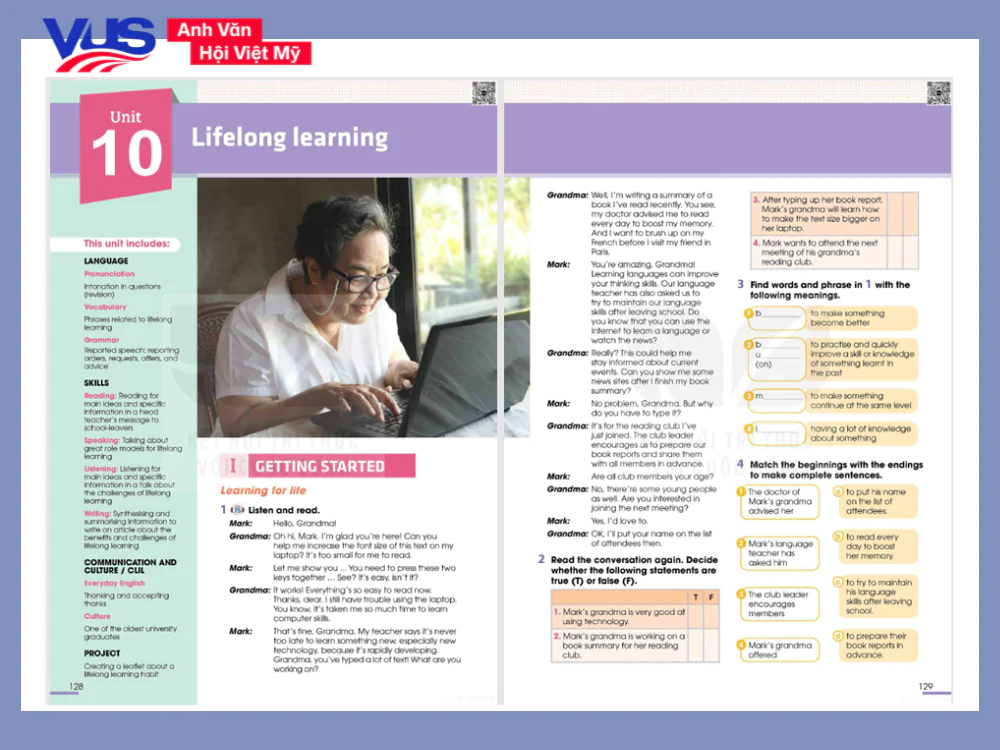
Tiếng Anh 12 Unit 10 Getting Started
Learning for life
1. Listen and read. (Học sinh thực hiện theo hướng dẫn của giáo viên)
2. Read the conversation again. Decide whether the following statements are true (T) or false (F).
|
T |
F |
||
|
1. Mark’s grandma is very good at using technology. |
✓ |
||
|
2. Mark’s grandma is working on a book summary for her reading club. |
✓ |
||
|
3. After typing up her book report, Mark’s grandma will learn how to make the text size bigger on her laptop. |
✓ |
||
|
4. Mark wants to attend the next meeting of his grandma’s reading club. |
✓ |
||
3. Find words and phrases in 1 with the following meanings.
- b__________ – to make something become better
- b__________ (up on) – to practise and quickly improve a skill or knowledge of something learnt in the past
- m__________ – to make something continue at the same level
- i__________ – having a lot of knowledge about something
Đáp án: 1. boost 2. brush up 3. maintain 4. informed
4. Match the beginnings with the endings to make complete sentences.
- The doctor of Mark’s grandma advised her
- Mark’s language teacher has asked him
- The club leader encourages members
- Mark’s grandma offered
a. to put his name on the list of attendees.
b. to read every day to boost her memory.
c. to try to maintain his language skills after leaving school.
d. to prepare their book reports in advance.
Đáp án: 1. b 2. c 3. d 4. a
Tiếng Anh 12 Unit 10 Language
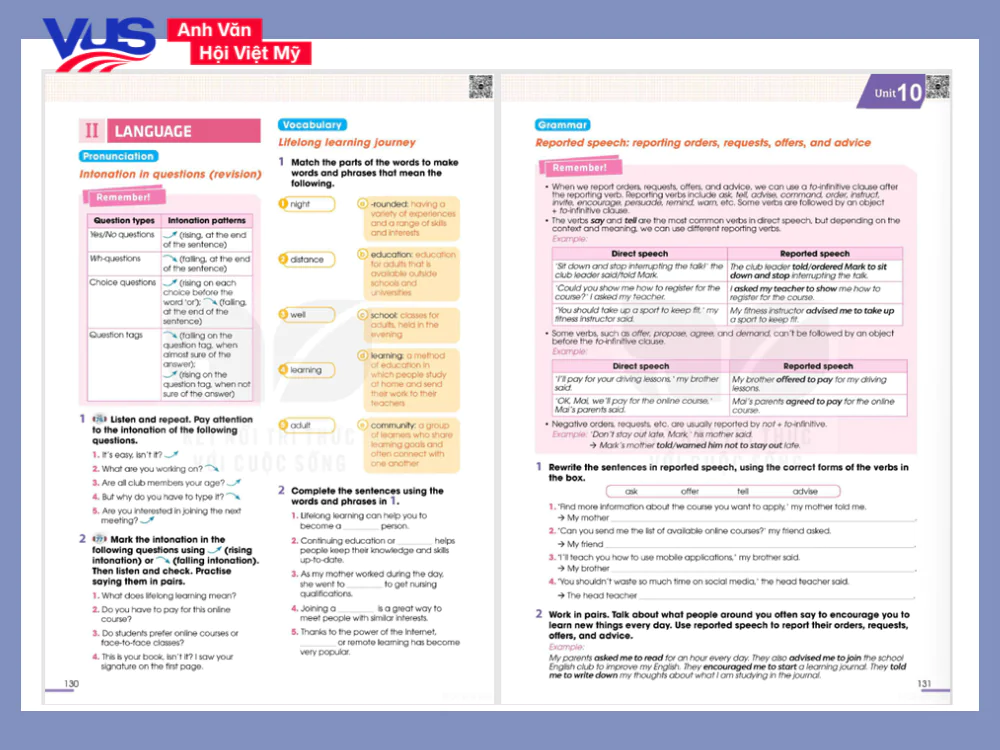
Pronunciation
Intonation in questions (revision)
1. Listen and repeat. Pay attention to the intonation of the following questions.
- It’s easy, isn’t it? ↗
- What are you working on? ↘
- Are all club members your age? ↗
- But why do you have to type it? ↘
- Are you interested in joining the next meeting? ↗
2. Mark the intonation in the following questions using ↗ (rising intonation) or ↘ (falling intonation). Then listen and check. Practise saying them in pairs.
- What does lifelong learning mean? ↘
- Do you have to pay for this online course? ↗
- Do students prefer online courses ↗ or face-to-face classes↘?
- This is your book, isn’t it? ↘ I saw your signature on the first page.
Vocabulary
Lifelong learning journey
1. Match the parts of the words to make words and phrases that mean the following.
- night
- distance
- well
- learning
- adult
a. rounded: having a variety of experiences and a range of skills and interests
b. education: education for adults that is available outside schools and universities
c. classes for adults, held in the evening
d. learning: a method of education in which people study at home and send their work to their teachers
e. community: a group of learners who share learning goals and often connect with one another
Đáp án:
- c (night school)
- d (distance learning)
- a (well-rounded)
- e (learning community)
- b (adult education)
2. Complete the sentences using the words and phrases in 1.
- Lifelong learning can help you to become a ______ person.
- Continuing education or ______ helps people keep their knowledge and skills up-to-date.
- As my mother worked during the day, she went to ______ to get nursing qualifications.
- Joining a ______ is a great way to meet people with similar interests.
- Thanks to the power of the Internet, ______ or remote learning has become very popular.
Đáp án:
- well-rounded
- adult education
- night school
- learning community
- distance learning
Grammar
Reported speech: reporting orders, requests, offers, and advice
1. Rewrite the sentences in reported speech, using the correct forms of the verbs in the box.
ask – offer – tell – advise
- “Find more information about the course you want to apply,” my mother told me.
→ My mother ________. - “Can you send me the list of available online courses?” my friend asked.
→ My friend ________. - “I’ll teach you how to use mobile applications,” my brother said.
→ My brother ________. - “You shouldn’t waste so much time on social media,” the head teacher said.
→ The head teacher ________.
Đáp án:
- My mother told me to find more information about the course I wanted to apply.
- My friend asked me to send him/her the list of available online courses.
- My brother offered to teach me how to use mobile applications.
- The head teacher advised me to spend less time on social media.
2. Work in pairs. Talk about what people around you often say to encourage you to learn new things every day. Use reported speech to report their orders, requests, offers, and advice.
Example:
My parents asked me to read for an hour every day. They also advised me to join the school English club to improve my English. They encouraged me to start a learning journal. They told me to write down my thoughts about what I am studying in the journal.
Gợi ý tham khảo:
1. My English teacher often tells me to practise English every day to improve my communication skills. She advised me to read English news and watch educational videos regularly. She also encouraged me to take part in speaking activities in class and not to be afraid of making mistakes. Recently, she offered to check my writing more carefully so that I could improve faster.
2. My parents always remind me that learning should continue even after school. My father told me to manage my time wisely and focus more on self-study. He advised me to set clear goals for each month and try to achieve them step by step. My mother encouraged me to learn practical skills for the future and offered to help me look for useful online courses.
3. My older sister also supports my learning journey. She asked me to try learning a new skill, such as graphic design or coding, to prepare for future opportunities. She advised me to explore different online platforms to gain more knowledge. She even offered to study with me at the weekend so that we could share ideas and motivate each other.
Tiếng Anh 12 Unit 10 Reading
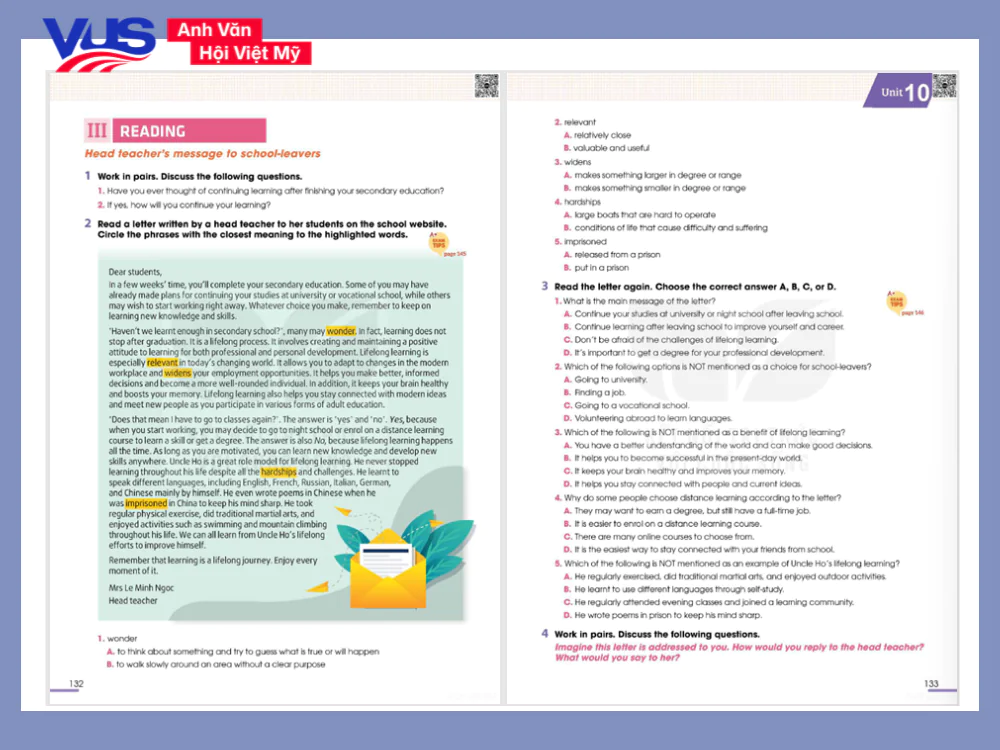
Head teacher’s message to school-leavers
1. Work in pairs. Discuss the following questions.
- Have you ever thought of continuing learning after finishing your secondary education?
- If yes, how will you continue learning?
Gợi ý tham khảo:
Yes, I have thought about continuing learning after finishing my secondary education. I want to become a software engineer in the future, so I know that I need to keep learning all the time because technology develops very quickly.
After secondary school, I plan to study Information Technology at university. Besides formal education, I will take online programming courses to improve my coding skills and learn new programming languages. I also want to join tech communities and work on small projects to gain practical experience. By continuing learning, I hope to build a successful career in the technology field.
2. Read a letter written by a head teacher to her students on the school website. Circle the phrases with the closest meaning to the highlighted words.
- wonder
A. to think about something and try to guess what is true or will happen
B. to walk slowly around an area without a clear purpose
- relevant
A. relatively close
B. valuable and useful - widens
A. makes something larger in degree or range
B. makes something smaller in degree or range - hardships
A. large boats that are hard to operate
B. conditions of life that cause difficulty and suffering - imprisoned
A. released from a prison
B. put in a prison
Đáp án: 1. A 2. B 3. A 4. B 5. B
3. Read the letter again. Choose the correct answer A, B, C or D.
- What is the main message of the letter?
A. Continue your studies at university or night school after leaving school.
B. Continue learning after leaving school to improve yourself and career.
C. Don’t be afraid of the challenges of lifelong learning.
D. It’s important to get a degree for your professional development. - Which of the following options is NOT mentioned as a choice for school-leavers?
A. Going to university.
B. Finding a job.
C. Going to a vocational school.
D. Volunteering abroad to learn languages. - Which of the following is NOT mentioned as a benefit of lifelong learning?
A. You have a better understanding of the world and can make good decisions.
B. It helps you to become successful in the present-day world.
C. It keeps your brain healthy and improves your memory.
D. It helps you stay connected with people and current ideas. - Why do people choose distance learning according to the letter?
A. They may want to earn a degree, but still have a full-time job.
B. It is easier to enrol in a distance learning course.
C. There are many online courses to choose from.
D. It is the easiest way to stay connected with your friends from school. - Which of the following is NOT mentioned as an example of Uncle Ho’s lifelong learning?
A. He regularly exercised, did traditional martial arts, and enjoyed outdoor activities.
B. He learnt to use different languages through self-study.
C. He regularly attended evening classes and joined a learning community.
D. He wrote poems in prison to keep his mind sharp.
Đáp án: 1. B 2. D 3. B 4. A 5. C
4. Work in pairs. Discuss the following questions.
Imagine this letter is addressed to you. How would you reply to the head teacher? What would you say to her?
Gợi ý tham khảo:
Dear Mrs Le Minh Ngoc,
Thank you very much for your meaningful letter. After reading it, I understand more clearly that learning does not stop after graduation. Your message has encouraged me to continue improving myself, no matter what path I choose in the future.
I plan to continue my studies at university to pursue my dream of becoming a software engineer. Besides formal education, I will also take online courses and develop new skills such as communication and critical thinking. I will try to keep a positive attitude towards learning and stay curious about the world around me.
Thank you again for your advice and inspiration. I will always remember that learning is a lifelong journey.
Sincerely,
[Your Name]
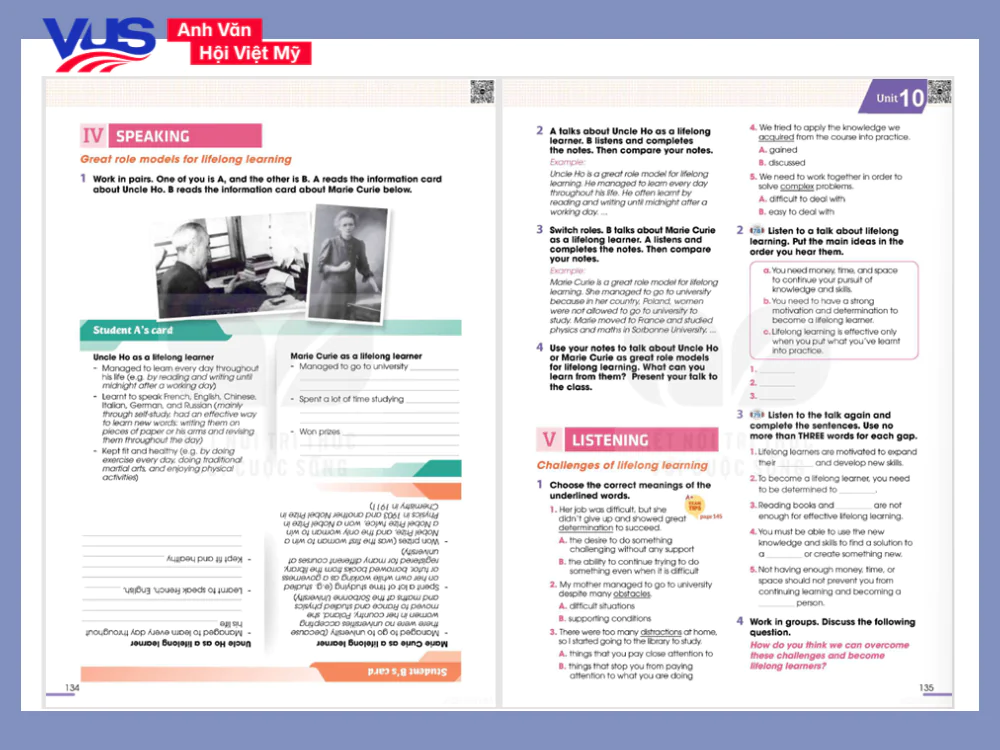
Tiếng Anh 12 Unit 10 Speaking
Great role models for lifelong learning
1. Work in pairs. One of you is A, and the other is B. A reads the information card about Uncle Ho. B reads the information card about Marie Curie below.
(Học sinh thực hiện theo hướng dẫn của giáo viên)
2. A talks about Uncle Ho as a lifelong learner. B listens and completes the notes. Then compare your notes.
Example:
Uncle Ho is a great role model for lifelong learning. He managed to learn every day throughout his life. He often learnt by reading and writing until midnight after a working day.
Gợi ý tham khảo:
Uncle Ho is a great role model for lifelong learning. He managed to learn every day throughout his life, even when he was very busy with work. He often studied by reading and writing until midnight after a long working day.
He learnt many foreign languages such as French, English, Chinese, Italian, German, and Russian mainly through self-study. Even when he was imprisoned, he continued learning by writing poems in Chinese to keep his mind sharp.
In addition, he always tried to improve both his mind and body. He kept fit by doing traditional martial arts and taking part in physical activities. His lifelong efforts show that learning never stops, no matter the circumstances.
3. Switch roles. B talks about Marie Curie as a lifelong learner. A listens and completes the notes. Then compare your notes.
Example:
Marie Curie is a great role model for lifelong learning. She managed to go to university because in her country, Poland, women were not allowed to go to university to study. Marie moved to France and studied physics and maths in Sorbonne University.
Gợi ý tham khảo:
Marie Curie is a great role model for lifelong learning. She worked very hard to pursue her education, even though women were not allowed to attend university in her home country, Poland. She later moved to France to continue her studies at Sorbonne University, where she studied physics and mathematics.
She spent a lot of time studying and doing scientific research. Thanks to her strong determination and passion for learning, she made important discoveries in science. She also won prestigious prizes for her achievements. Her lifelong dedication to study and research shows that continuous learning can lead to great success.
4. Use your notes to talk about Uncle Ho or Marie Curie as great role models for lifelong learning. What can you learn from them? Present your talk to the class.
Gợi ý tham khảo:
Today, I would like to talk about Uncle Ho as a great role model for lifelong learning. Throughout his life, he never stopped learning, even when he was very busy or faced many hardships. He often studied by reading and writing until midnight after a long working day. He also learnt many foreign languages mainly through self-study. Even when he was imprisoned, he continued writing poems to keep his mind active and sharp. In addition, he paid attention to his physical health by doing traditional martial arts and other activities.
From Uncle Ho, I learn that learning does not depend on age or circumstances. We should always stay curious, determined, and disciplined. No matter how difficult life is, we can continue improving ourselves every day.
Tiếng Anh 12 Unit 10 Listening
Challenges of lifelong learning
1. Choose the correct meanings of the underlined words.
- Hu has difficulty, but she didn’t give up and showed great determination to succeed.
A. the desire to do something challenging without any support
B. the ability to continue trying to do something even when it is difficult - My mother managed to go to university despite many obstacles.
A. difficult situations
B. supporting conditions - There were too many distractions at home, so I started going to the library to study.
A. things that you pay close attention to
B. things that stop you from paying attention to what you are doing - We tried to apply the knowledge we acquired from the course into practice.
A. gained
B. discussed - We need to work together in order to solve complex problems.
A. difficult to deal with
B. easy to deal with
Đáp án: 1. B 2. A 3. B 4. A 5. A
2. Listen to a talk about lifelong learning. Put the main ideas in the order you hear them.
Đáp án: 1. B 2. C 3. A
3. Listen to the talk again and complete the sentences. Use no more than THREE words for each gap.
- Lifelong learners are motivated to expand their ______ and develop new skills.
- To become a lifelong learner, you need to be determined to ______.
- Reading books and ______ are not enough for effective lifelong learning.
- You must be able to use the new knowledge and skills to find a solution to ______ or create something new.
- Not having enough money, time, or space should not prevent you from continuing learning and becoming a ______ person.
Đáp án:
- knowledge
- achieve your goals
- collecting information
- complex problem
- well-rounded
4. Work in groups. Discuss the following question.
How do you think we can overcome these challenges and become lifelong learners?
Gợi ý tham khảo:
I think we can overcome these challenges by setting clear and realistic learning goals. When we know what we want to achieve, it is easier to stay motivated and focused. We should also create a study plan and manage our time effectively so that learning becomes a daily habit, not a burden.
In addition, we can reduce distractions by choosing a quiet place to study and limiting the time we spend on social media. Joining a learning community is also helpful because we can share knowledge, support each other, and stay inspired. Most importantly, we need to keep a positive attitude and not give up when learning becomes difficult. If we are determined and patient, we can become lifelong learners.
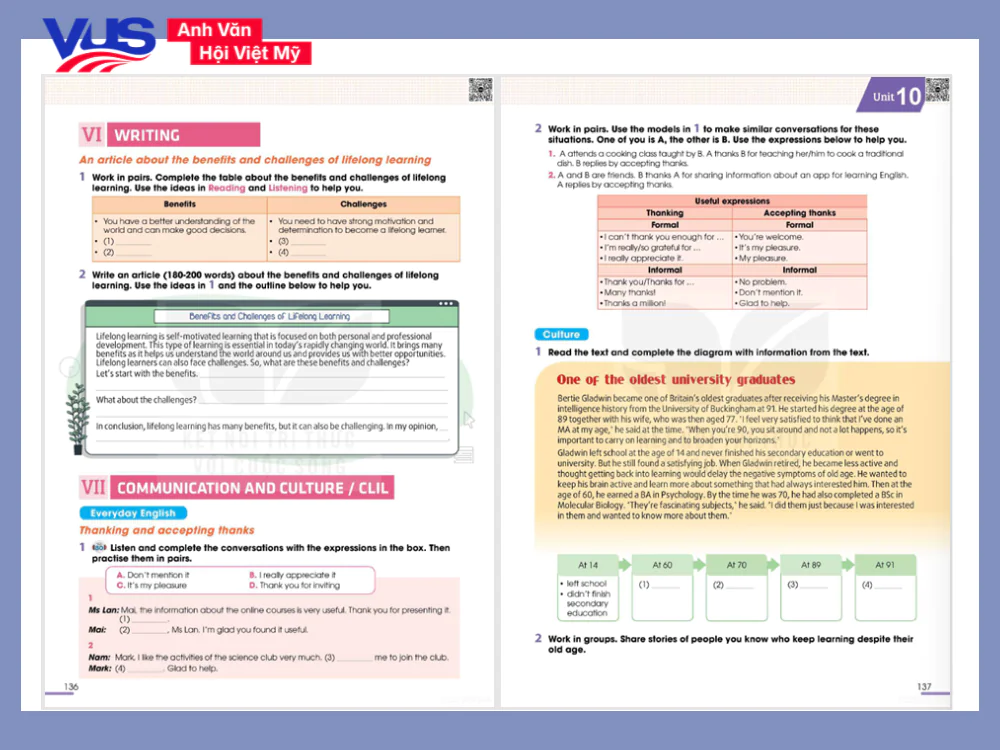
Tiếng Anh 12 Unit 10 Writing
An article about the benefits and challenges of lifelong learning
1. Work in pairs. Complete the table about the benefits and challenges of lifelong learning. Use the ideas in Reading and Listening to help you.
Gợi ý tham khảo:
|
Benefits |
Challenges |
|
You have a better understanding of the world and can make good decisions. |
You need to have strong motivation and determination to become a lifelong learner. |
|
(1) It widens your employment opportunities and helps you adapt to changes in the modern workplace. |
(3) You may not have enough money, time, or space to continue learning. |
|
(2) It keeps your brain healthy, boosts your memory, and helps you become a well-rounded person. |
(4) There may be many distractions that prevent you from focusing on learning. |
2. Write an article (180–200 words) about the benefits and challenges of lifelong learning. Use the ideas in 1 and the outline below to help you.
Gợi ý tham khảo:
Lifelong learning is self-motivated learning that is focused on both personal and professional development. This type of learning is essential in today’s rapidly changing world. It brings many benefits as it helps us understand the world around us and provides us with better opportunities. Lifelong learners can also face challenges. So, what are these benefits and challenges?
Let’s start with the benefits. Lifelong learning helps us widen our employment opportunities and adapt to changes in the modern workplace. It also allows us to make informed decisions and become more well-rounded individuals. In addition, continuous learning keeps our brains active, improves our memory, and helps us stay connected with new ideas and people.
What about the challenges? To become a lifelong learner, we need strong motivation and determination. Many people face difficulties such as a lack of time, money, or a suitable learning environment. There are also distractions that make it hard to stay focused. Overcoming these obstacles requires discipline and good time management.
In conclusion, lifelong learning has many benefits, but it can also be challenging. In my opinion, with a positive attitude and perseverance, anyone can become a successful lifelong learner.
Tiếng Anh 12 Unit 10 Communication and Culture / CLIL
Everyday English
Thanking and accepting thanks
1. Listen and complete the conversations with the expressions in the box. Then practise them in pairs.
A. Don’t mention it.
B. I really appreciate it.
C. It’s my pleasure.
D. Thank you for inviting me.
1.
Ms Lan: Mai, the information about the online courses is very useful. Thank you for presenting it. (1) ______.
Mai: (2) ______. Ms Lan. I’m glad you found it useful.
2.
Nam: Mark, I like the activities of the science club very much. (3) ______ me to join the club.
Mark: (4) ______. Glad to help.
Đáp án: 1. C 2. B 3. D 4. A
2. Work in pairs. Use the models in 1 to make similar conversations for these situations. One of you is A, the other is B. Use the expressions below to help you.
Gợi ý tham khảo:
Situation 1: Cooking class (formal)
A: I’m really grateful for teaching me how to cook this traditional dish. I can’t thank you enough for your detailed instructions.
B: You’re welcome. It’s my pleasure. I’m glad you enjoyed the class.
A: I really appreciate it. Now I feel much more confident in the kitchen.
B: My pleasure. Keep practising and you’ll become even better.
Situation 2: Sharing an English learning app (informal)
B: Thanks a million for sharing that English learning app with me. It’s really useful.
A: No problem. Glad to help.
B: Thank you for explaining how to use it, too.
A: Don’t mention it. I hope it helps you improve your English quickly.
Culture
1. Read the text and complete the diagram with information from the text.
One of the oldest university graduates
Bertie Gladwin became one of Britain’s oldest graduates after receiving his Master’s degree in intelligence history from the University of Buckingham at 91. He started his degree at the age of 89 together with his wife, who was then aged 77. “I feel very satisfied to think that I’ve done an MA at my age,” he said at the time. “When you’re 90, you sit around and not a lot happens, so it’s important to carry on learning and to broaden your horizons.”
Gladwin left school at the age of 14 and never finished his secondary education or went to university. But he still found a satisfying job. When Gladwin retired, he became less active and thought getting back into learning would delay the negative symptoms of old age. He wanted to keep his brain active and learn more about something that he always interested in. Then at the age of 60, he earned a BA in Psychology. By the time he was 70, he had also completed a BSc in Molecular Biology. “They’re fascinating subjects,” he said. “I did them just because I was interested in them and wanted to know more about them.”
Diagram:
- At 14: left school; didn’t finish secondary education
- At 60: (1) ______
- At 70: (2) ______
- At 89: (3) ______
- At 91: (4) ______
Đáp án:
- earned a BA in Psychology
- completed a BSc in Molecular Biology
- started his Master’s degree
- received his Master’s degree
2. Work in groups. Share stories of people you know who keep learning despite their old age.
Gợi ý tham khảo:
In my group, we talked about my grandfather as an example of lifelong learning. Although he is over 70 years old, he still spends time reading books and newspapers every day to keep himself informed. A few years ago, he even learned how to use a smartphone so that he could video call his grandchildren. At first, he found it difficult, but he didn’t give up. He asked us to show him how to use different applications and practised regularly.
We also shared a story about our neighbour, who decided to learn English after retiring. She attends night classes twice a week and studies at home every evening. She says learning helps her keep her mind active and feel more confident. These stories show that age is not a barrier to learning.
Tiếng Anh 12 Unit 10 Looking Back
Pronunciation
Mark the intonation in the following questions. Then listen and check. Practise saying them in pairs.
- When was the last meeting of your reading club? ↘
- Is lifelong learning important for career development? ↗
- You don’t attend night school classes, do you? ↘ I’ve never seen you before.
- Is the course held on weekdays ↗ or at the weekend ↘?
Vocabulary
2. Complete the text. Use the correct forms of the words and phrases in the box.
learning community – well-rounded – relevant – adult education – distance learning
Lifelong learning is especially (1) ______ in today’s fast changing world. There are many ways to engage in lifelong learning. First, you can attend courses at (2) ______ institutions. Second, you can also take remote or (3) ______ courses with the help of technology. Third, you can join a (4) ______ of people who share common learning goals. And finally, you can learn by reading widely and researching topics. This will help you become (5) ______ and prepare you to face future challenges.
Đáp án:
- relevant
- adult education
- distance learning
- learning community
- well-rounded
Grammar
Choose the sentence that has the closest meaning to the given sentence.
- “You should continue learning after leaving school,” my grandfather said.
A. My grandfather advised me to continue learning after leaving school.
B. I advised my grandfather to continue learning after leaving school.
C. My grandfather didn’t want me to continue learning after leaving school.
D. I didn’t want my grandfather to continue learning after leaving school. - “I’ll help you register for the course,” my sister said.
A. My sister forced me to register for her course.
B. My sister offered to help me register for the course.
C. I wanted to help my sister register for the course.
D. I wanted my sister to register for the course. - “Can you show me how to download this video?” my mother asked.
A. I asked my mother to show me how to download that video.
B. I showed my mother how to download that video.
C. My mother asked me to show her how to download that video.
D. My mother showed me how to download that video. - “Don’t enter your sister’s room. She is studying,” my father told me.
A. My sister ordered me not to enter her room because she was studying.
B. My sister ordered my father not to enter her room because she was studying.
C. I ordered my father not to enter my sister’s room because she was studying.
D. My father ordered me not to enter my sister’s room because she was studying.
Đáp án: 1. A 2. B 3. C 4. D
Tiếng Anh 12 Unit 10 Project
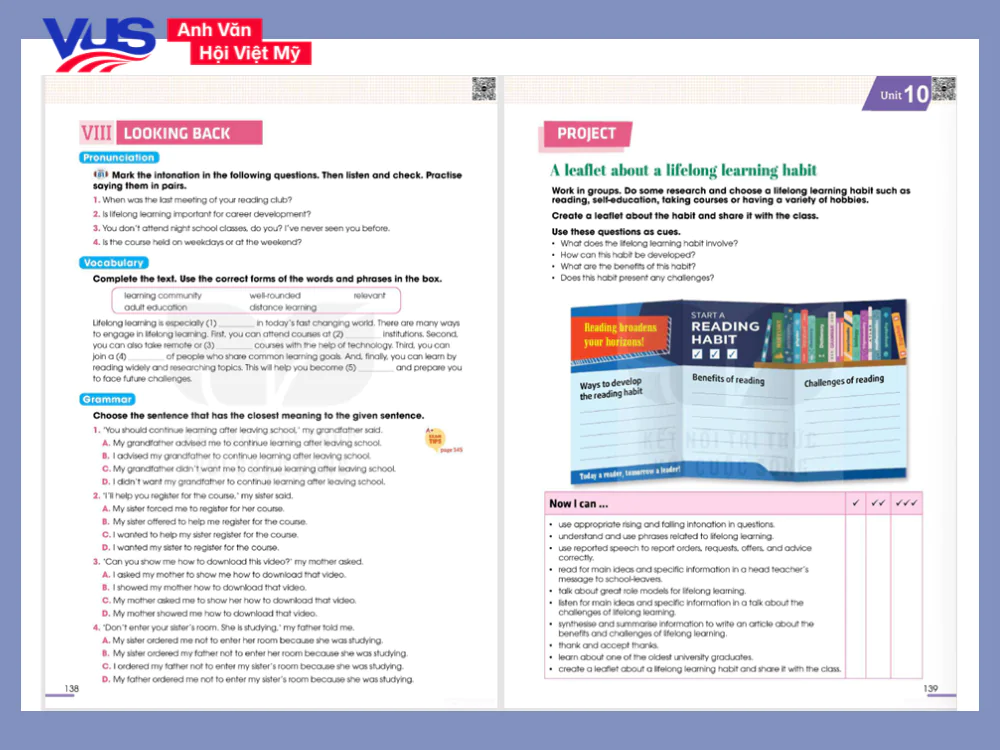
PROJECT
A leaflet about a lifelong learning habit
Work in groups. Do some research and choose a lifelong learning habit such as reading, self-education, taking courses or having a variety of hobbies. Create a leaflet about the habit and share it with the class.
Use these questions as cues.
- What does this lifelong learning habit involve?
- How can this habit be developed?
- What are the benefits of this habit?
- Does this habit present any challenges?
(Học sinh thực hiện theo hướng dẫn của giáo viên)
Xem thêm:
Nếu xem Unit 10 – Lifelong Learning như một “lời nhắc” rằng việc học không dừng lại sau tốt nghiệp, thì IELTS là một trong những mục tiêu học tập suốt đời rõ ràng và “đáng đầu tư” nhất:
bạn không chỉ học để lấy chứng chỉ, mà còn rèn tư duy học thuật, kỹ năng đọc – viết – trình bày lập luận, và khả năng giao tiếp quốc tế cho đại học, học bổng, du học hay công việc tương lai.
Điểm hay của IELTS là càng học đúng cách, bạn càng thấy mình tiến bộ theo từng mốc nhỏ – giống như một hành trình “carry on learning” đúng nghĩa.
Và nếu bạn đang cần một lộ trình bài bản để biến tinh thần lifelong learning thành kết quả cụ thể (band điểm + kỹ năng dùng được), VUS là lựa chọn phù hợp khi bạn muốn học nghiêm túc nhưng vẫn cần sự đồng hành rõ ràng.
VUS có hệ thống đào tạo quy mô lớn với 2.700+ giáo viên & trợ giảng, đội ngũ giảng dạy đạt chuẩn (100% giáo viên có bằng cử nhân trở lên và chứng chỉ giảng dạy quốc tế như TESOL/CELTA/TEFL) và hệ thống quản lý chất lượng chuyên sâu (100% quản lý chất lượng có bằng thạc sĩ/tiến sĩ).
Trung tâm cũng là Đối tác Platinum của British Council, vì vậy trải nghiệm luyện thi và chuẩn hóa chất lượng được đầu tư bài bản theo chuẩn quốc tế.
Điểm khác biệt của khóa IELTS tại VUS nằm ở việc bạn không chỉ “làm đề cho nhiều”, mà được cung cấp đúng thứ cần tăng band: xây nền 4 kỹ năng, quen format, luyện chiến thuật, và đặc biệt là luyện theo hướng feedback – sửa lỗi – nâng cấp.
Lộ trình học kết hợp giáo trình Mindset for IELTS (Cambridge University Press) cùng tài liệu do VUS biên soạn và ngân hàng đề thi thử được cập nhật để bạn luyện đúng trọng tâm theo mục tiêu điểm số.
Trong quá trình học, bạn nhận được những quyền lợi thiết thực để duy trì nhịp học đều (rất đúng tinh thần “lifelong learning”):
- Bài kiểm tra trình độ miễn phí để xếp lớp đúng năng lực và mục tiêu.
- IELTS Mock Test phối hợp cùng British Council giúp bạn làm quen trải nghiệm thi trên máy và tự tin hơn khi vào phòng thi thật.
- App luyện IELTS 24/7: hỗ trợ luyện phát âm với AI và writing được giáo viên sửa để bạn nhìn ra lỗi thật sự và cải thiện theo từng tuần.
- Lộ trình có cam kết kết quả (theo điều kiện chương trình), giúp bạn học có mục tiêu và đo được tiến bộ.
Quan trọng hơn, VUS có nền tảng thành tích và uy tín đào tạo để bạn yên tâm theo học dài hạn: gần 21.000 học viên đạt điểm tuyệt đối ở các chứng chỉ quốc tế (Starters, Movers, Flyers, KET, PET, IELTS) tính đến 08/09/2024.
Trung tâm cũng được Cambridge vinh danh, với chứng nhận “Trung Tâm Đào Tạo Vàng” 5 năm liên tiếp (thông tin công bố 10/02/2025).
→ Những cột mốc này không chỉ là con số, mà là “bằng chứng” cho một hệ thống có thể hỗ trợ bạn học đúng phương pháp và bền bỉ đến đích.
Tham khảo chi tiết: Khóa học IELTS tại VUS – Học đúng trọng tâm, luyện đúng cách
Nếu bạn muốn bắt đầu hành trình IELTS theo cách chắc chắn hơn (biết mình đang ở đâu, cần sửa gì, đi lộ trình nào để đạt band mục tiêu), bạn có thể đăng ký tư vấn và kiểm tra trình độ miễn phí ngay bên dưới để nhận được lộ trình phù hợp và lựa chọn lớp học đúng năng lực ngay từ đầu.

Các bài tập ôn kiến thức tiếng Anh 12 Unit 10 Lifelong learning
Dưới đây là hệ thống bài tập giúp học sinh củng cố từ vựng, ngữ pháp và kỹ năng trọng tâm trong tiếng Anh 12 Unit 10 Lifelong learning. Các dạng bài bám sát nội dung bài học và cấu trúc thường gặp trong bài kiểm tra.
Bài tập 1: Chọn đáp án đúng (Vocabulary)
Chọn đáp án đúng A, B, C hoặc D.
- Lifelong learning helps people stay ______ in a rapidly changing world.
A. relevant
B. bored
C. isolated
D. limited - Many adults return to ______ to improve their career prospects.
A. kindergarten
B. adult education
C. playground
D. nursery school - ______ allows students to study without attending classes in person.
A. Night school
B. Distance learning
C. Outdoor learning
D. Peer learning - Being ______ means having a variety of skills and knowledge.
A. narrow-minded
B. well-rounded
C. careless
D. outdated - A strong learning ______ encourages students to share ideas and support one another.
A. community
B. environment
C. building
D. library
Đáp án: 1. A – 2. B – 3. B – 4. B – 5. A
Bài tập 2: Viết lại câu (Reported Speech)
Chuyển các câu sau sang câu gián tiếp.
- “Find more information about the course,” my teacher said to me.
→ My teacher told me ____________________________________. - “Can you send me the list of online courses?” she asked.
→ She asked me ____________________________________. - “I will help you prepare for the exam,” he said.
→ He offered ____________________________________. - “Don’t spend too much time on social media,” my father said.
→ My father advised me ____________________________________.
Đáp án gợi ý:
- to find more information about the course.
- to send her the list of online courses.
- to help me prepare for the exam.
- not to spend too much time on social media.
Bài tập 3: Hoàn thành đoạn văn (Reading – Cloze test)
Điền các từ sau vào chỗ trống:
knowledge – goals – information – lifelong – skills
Lifelong learning is the process of gaining (1) __________ throughout your life. It helps people achieve their personal and professional (2) __________. In the digital age, collecting (3) __________ from reliable sources is an important skill. Developing new (4) __________ makes individuals more adaptable. A (5) __________ learner never stops improving.
Đáp án:
- knowledge
- goals
- information
- skills
- lifelong
Sau khi hoàn thành toàn bộ nội dung Tiếng Anh 12 Unit 10 Lifelong Learning, bạn không chỉ nắm chắc từ vựng và ngữ pháp trọng tâm mà còn hiểu rõ cách làm từng dạng bài theo các kỹ năng Reading, Speaking, Listening, Writing,...
Việc ôn tập thường xuyên với hệ thống đáp án chi tiết và bài tập củng cố sẽ giúp bạn ghi nhớ kiến thức lâu hơn và hạn chế sai sót khi làm bài.
Câu hỏi thường gặp về tiếng Anh 12 Unit 10: Lifelong learning
-
Tiếng Anh 12 Unit 10 Reading nói về điều gì?
 Phần Tiếng Anh 12 Unit 10 Reading xoay quanh chủ đề lifelong learning thông qua “Head teacher’s message to school-leavers”. Nội dung nhấn mạnh việc tiếp tục học tập sau khi hoàn thành secondary education, lợi ích của lifelong learning và những tấm gương như Uncle Ho. Bài đọc giúp học sinh hiểu sâu hơn về ý nghĩa của việc học suốt đời.
 -
Tiếng Anh 12 Unit 10 Speaking yêu cầu làm gì?
Trong Tiếng Anh 12 Unit 10 Speaking, học sinh thảo luận về great role models for lifelong learning. Các em được nói về Uncle Ho hoặc Marie Curie và trình bày những điều có thể học hỏi từ họ. Phần này rèn luyện kỹ năng trình bày ý tưởng rõ ràng và liên hệ thực tế với chủ đề lifelong learning. -
Tiếng Anh 12 Unit 10 Writing cần viết bài gì?
Phần Tiếng Anh 12 Unit 10 Writing yêu cầu viết một bài khoảng 180–200 words về Benefits and Challenges of Lifelong Learning. Học sinh cần trình bày lợi ích như hiểu rõ thế giới, mở rộng cơ hội việc làm, đồng thời phân tích những thách thức như thiếu thời gian hoặc động lực. Bài viết giúp phát triển kỹ năng lập luận và tổng hợp ý tưởng.


100% giáo viên tại VUS sở hữu chứng chỉ giảng dạy tiếng Anh Quốc tế (TESOL, CELTA,…). VUS tiên phong phát triển phương pháp giảng dạy Discovery Learning (Học Thông Qua Khám Phá) được phát triển dựa trên triết lý giáo dục Constructivism (Kiến tạo) – nơi học viên không chỉ học một ngôn ngữ, mà còn học cách tư duy, phản biện và làm chủ tri thức.


![Bảng quy đổi điểm IELTS Đại học Sư phạm Hà Nội 2026 [CẬP NHẬT]](https://static.io.vn/webroot/upload/202606/38c96db0012682d2b8e2a2cbb26ba467.webp?v=1.2026.246 "Bảng quy đổi điểm IELTS Đại học Sư phạm Hà Nội 2026 [CẬP NHẬT]")


![[MỚI] Du học Canada cần IELTS bao nhiêu? Cập nhật theo bậc học](https://static.io.vn/webroot/upload/202602/5f73bcc7c6a548ca4057672c5cb45b20.webp?v=1.2026.246 "[MỚI] Du học Canada cần IELTS bao nhiêu? Cập nhật theo bậc học")


![[MỚI] Du học Úc cần IELTS bao nhiêu? Điều kiện từng bậc học](https://static.io.vn/webroot/upload/202602/1521d3ca156b9238c755406402332c64.webp?v=1.2026.246 "[MỚI] Du học Úc cần IELTS bao nhiêu? Điều kiện từng bậc học")


Vui lòng để lại thông tin phía dưới để được tư vấn miễn phí

Phạm Việt Thục Đoan
IELTS
8.5

Doãn Bá Khánh Nguyên
IELTS
8.5

Nguyễn Lê Huy
IELTS
8.0

Võ Ngọc Bảo Trân
IELTS
8.0

Nguyễn Đăng Minh Hiển
144
KET

Ngô Nguyễn Bảo Nghi
143
KET

Đỗ Huỳnh Gia Hân
Starters
15
Khiên

Võ Nguyễn Bảo Ngọc
Starters
15
Khiên

Nguyễn Võ Minh Khôi
Movers
15
Khiên

Nguyễn Đặng Nhã Trúc
Starters
15
Khiên
Môi trường học tập
chuẩn Quốc tế
Cơ sở vật chất, giáo viên và chứng nhận từ đối tác quốc tế mang đến môi trường giáo dục tiếng Anh chất lượng với trải nghiệm học tập toàn diện cho học viên.


Vui lòng để lại thông tin phía dưới để được tư vấn miễn phí
